The AI Gold Rush Has a New Face the Product Manager
In 2025, AI isn’t just changing the way we work, it's changing who drives the work.
Across Indian tech corridors from Bengaluru’s Koramangala to Gurgaon’s Cyber Hub there’s a new role everyone’s raving about:
The AI Product Manager.
They’re not coders. They’re not data scientists.
They’re the translators turning machine intelligence into human impact.
And companies are paying big for that superpower.
The average AI Product Manager salary in India in 2025 sits between ₹18 and ₹42 lakhs, with startups dangling stock options and bonuses to lure the best minds.
But how do you become one? What skills get you there?
And how does this role actually evolve into a career with purpose and pay?
Let’s decode the numbers, the path, and the opportunity.
So, How Much Does an AI Product Manager Earn in India (2025)?
Let’s get straight to the numbers.
Across the top 100 Indian startups and tech companies, here’s what the data says:
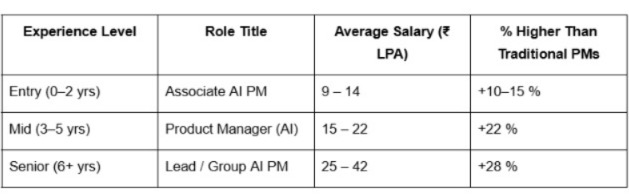
Why the premium?
Because these PMs don’t just “launch features” they design intelligence.
They decide how LLMs talk, how recommendation models predict, and how products learn.
In companies like Swiggy, Paytm, and Razorpay, AI PMs directly influence business KPIs personalization, automation, fraud reduction, and user retention.
And when your product thinking moves metrics at scale, your compensation follows.
The Fastest Career Growth Curve in Tech
Imagine this:
You start as an Associate AI PM, owning one model or micro-feature.
Three years later, you’re leading an AI-first product vertical with your own data scientists.
By year six, you’re the Head of AI Strategy, driving company-wide initiatives.
That’s not hypothetical, it's the actual growth trajectory visible on LinkedIn today.
Average time to senior PM: 4.5 years (vs 6.8 years in traditional PM roles).
Average salary jump per promotion: 35–40 %.
How to Become an AI Product Manager (Even Without Coding)
Good news you don’t need to be a coder.
You need to be a translator of intelligence.
Here’s your roadmap to transition:
Step 1. Master Core Product Thinking
Before you add “AI,” you must master the fundamentals of Product Management: how to identify problems, validate solutions, and measure success.
Start by learning how top PMs think:
Understand user discovery, problem framing, metrics, and GTM.
Build a strong foundation in product strategy and lifecycle thinking.
Read Next: 15 Most Important Metrics for Product Managers to Track
Learn how metrics drive real product decisions and influence every AI feature you’ll ever design.
Step 2. Learn AI Fluency (Not Code)
You don’t need to train models, you need to understand how they think.
AI fluency means grasping the basics of machine learning, LLMs, prompt engineering, APIs, and ethical AI.
Explore these beginner-friendly reads:
45+ ChatGPT Prompts For Product Managers Use AI to brainstorm features, write PRDs, and analyze data faster.
APIs for Product Managers: A Non-Technical Guide Learn how APIs power modern AI products without writing a single line of code.
Once you grasp this layer, you’ll be able to talk to engineers, data scientists, and stakeholders in the same language — AI fluency is your new edge.
Step 3. Build Real Projects
Theory doesn’t get you hired, proof does.
Start building simple, real-world projects:
- An AI chatbot MVP for your favorite use case
- A personalized recommendation model
- A dashboard using ChatGPT APIs for customer insights
Each project you create builds your product story, one that recruiters and hiring managers love.
Step 4. Document Everything
Your portfolio is your resume.
Use Notion, GitHub, or Super.so to showcase your projects with clear outcomes, frameworks, and visuals.
Include sections like:
✅ Problem → Solution → Impact
✅ Tools used (ChatGPT, LangChain, Visily AI, Bolt.new, etc.)
✅ What business metric your idea improved
It’s not just about what you built, it's about how you think.
That’s what separates a good PM from a great AI PM.
Step 5. Upskill via Specialized Programs
Finally, to accelerate your transition, learn through structured, guided mentorship.
That’s exactly what the AI-First Product Management Fellowship (PMF) offers.
It combines:
Real-world product frameworks
Hands-on AI product building
1:1 mentorship from PMs at Google & Microsoft
Portfolio creation + placement assistance
PMF graduates have achieved 35–50% average salary hikes within 6–9 months, landing roles at Swiggy, Ola, Deloitte, and Walmart.
What Drives AI PM Salaries Higher
There are three variables that determine your paycheck as an AI PM:
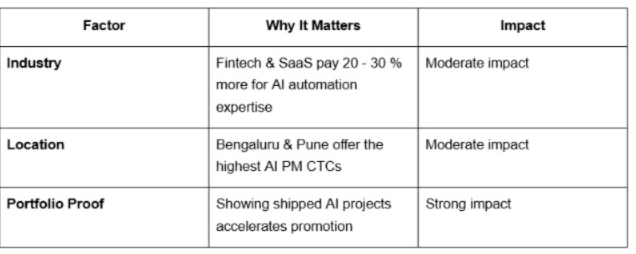
Bonus & Equity:
Mid-to-senior PMs often get 10–20 % bonuses and ESOPs worth ₹5–10 lakhs/year.
That means your total CTC can cross ₹50 lakhs at top-tier startups.
AI PM vs Traditional PM: The 2025 Pay Gap
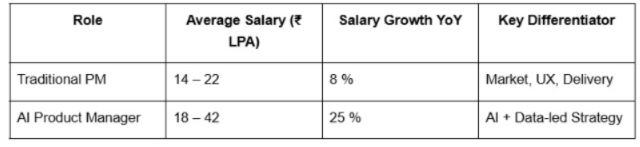
AI PMs are not replacing PMs - they’re evolving them.
Just like “digital marketers” redefined marketing a decade ago, “AI PMs” are redefining product management today.
Demand is Exploding and It’s Just the Start
Between 2023–2025, the number of “AI Product Manager” job postings on LinkedIn India grew 170 %.
Top hiring companies in India (2025):
- Meesho (AI PM, Personalization)
- Razorpay (AI PM, Fraud & Risk)
- Swiggy (AI PM, Recommendations)
- Zoho (AI PM, Generative AI)
- Fractal (AI PM, Analytics Platforms)
The global market for AI PMs is expected to touch $8.2 billion by 2030, with India emerging as a talent exporter for AI-first product leadership.
Your AI PM Portfolio: The Real Career Catalyst
Hiring managers care less about what you learned and more about what you built.
That’s why a killer portfolio is your biggest leverage.
Ideas that you could work on:
- AI chatbot MVP case study
- Feature doc for an AI-driven recommendation engine
- KPI dashboard for AI feature performance
- Use-case evaluation framework for LLM integrations
Show them you can think, not just talk.
Your portfolio turns your learning into leadership proof.
Real Outcomes: Why AI-First PM Is the Career of the Decade
Let’s recap with clarity:
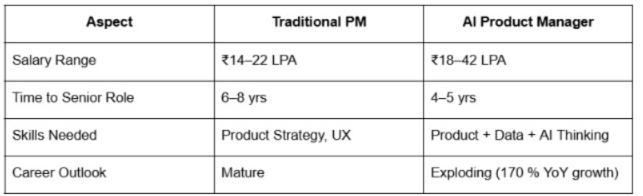
The future belongs to those who know how to teach machines to think humanly.
And that’s what AI Product Managers do.
Final Thought: Don’t Just Build Products Build Intelligence
If you’ve been a product thinker waiting for the next big wave this is it.
The shift to AI-first product thinking is as big as the internet or smartphone revolution.
You can either watch it unfold, or become the one who leads it.
Start your AI Product Management journey now, build your first AI case study today.