


Introduction
Choosing the right AI tool in 2026 is no longer about curiosity or experimentation. It’s about staying relevant, improving your output, and working at a level that matches the pace of the world around you.
But with hundreds of tools emerging every year, the real question becomes:
Which tools are worth your time, and which ones will actually move your career forward?
This guide breaks down the top 20 AI tools shaping 2026 in a way that’s easy to understand, regardless of whether you’re an aspiring professional or a senior leader making strategic decisions.

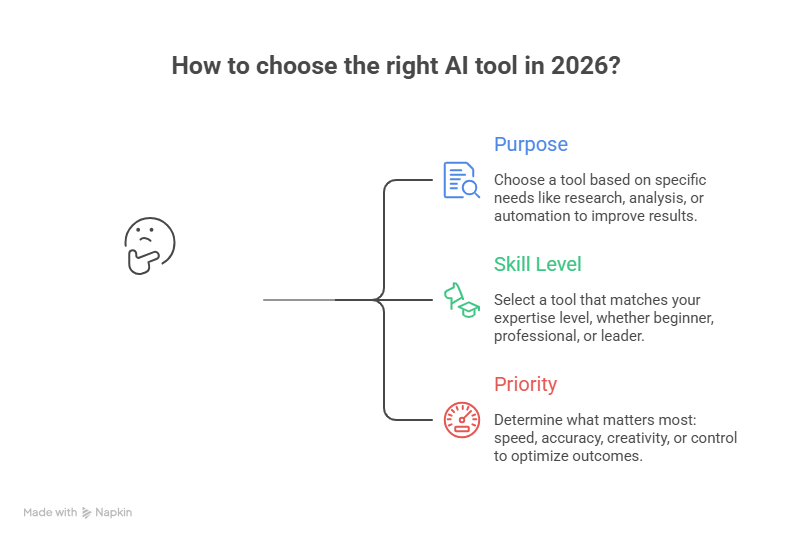
How to Choose the Right AI Tool in 2026
Before diving into the list, it helps to simplify the decision-making process.
1. What do you need the tool to do?
Research? Analysis? Writing? Automation? Coding? Design?
When you choose a tool based on a clear purpose, the results improve dramatically.
2. What is your skill level?
Beginners need guided tools.
Professionals need flexible tools.
Leaders need scalable tools.
3. What matters more: speed, accuracy, creativity, or control?
Different tools are optimised for different outcomes.
Once these three questions are clear, selecting the right tool becomes straightforward.
The Top 20 AI Tools of 2026
Organised by category so you can choose based on your goals.
A. Tools for Research, Writing and Communication
1. ChatGPT
A general-purpose AI that excels at writing, explanations, idea development, and communication support.
Best for: day-to-day productivity and clear communication.
2. Claude
Exceptional for long-form writing, analysis and structured thought.
Best for: reports, complex reasoning, deep work.
3. Perplexity
A research-focused AI that combines search with summarisation.
Best for: anyone who spends time reading, analysing or fact-checking.
4. Gemini
A strong multimodal AI that understands images, videos and documents.
Best for: users deeply embedded in Google's ecosystem.
B. Tools for Coding, Technical Work and Automation
5. GitHub Copilot
A coding assistant that speeds up development, debugging and documentation.
Best for: engineers and beginners learning to code.
6. Cursor AI / Replit AI
Full coding environments with built-in agent support.
Best for: startups, student builders, and rapid prototyping.
7. LangChain and LangGraph
Frameworks for building agents, automations and multi-step workflows.
Best for: advanced users, AI builders, and product teams.
C. Tools for Knowledge Management and Workflows
8. Notion AI
A unified workspace for tasks, documents and note-taking with integrated AI support.
Best for: personal organisation and team documentation.
9. Airtable AI / ClickUp AI
Workflow and task management with AI-powered automation.
Best for: operational teams and early-stage founders.
10. Pinecone / Weaviate
Vector databases for storing and retrieving company knowledge.
Best for: building AI search or RAG applications.
D. Tools for Design and Visual Creation
11. Midjourney
High-quality image generation for branding and concept design.
Best for: designers, marketers and creative professionals.
12. Runway
AI-driven video creation and editing.
Best for: short-form video creators, startups and media teams.
13. Canva AI
A simple design tool with strong templates and assisted editing.
Best for: non-designers producing high-quality visuals.
14. Ideogram / Leonardo AI
Tools designed for text-accurate image creation.
Best for: social media content, posters and advertisements.
E. Tools for Audio, Video and Content Production
15. Descript
Edit videos and podcasts by editing text.
Best for: creators and teams producing training content.
16. Synthesia
AI avatar-based video creation for education and training.
Best for: L&D teams, educators, and product tutorials.
17. ElevenLabs
High-quality voice generation and voice cloning.
Best for: narration, podcasts, training videos and ads.
F. Tools for Data, Analysis and Decision-Making
18. Tableau AI / Power BI AI
Dashboards with automated insights and assisted analysis.
Best for: leaders, analysts and product teams.
19. DeepSeek
Well-known for reasoning accuracy, problem-solving and technical work.
Best for: analytical tasks, modelling and logic-heavy work.
20. Rewind / Personal AI Agents
Personal memory and productivity tools that capture, search and retrieve everything you work on.
Best for: high-output professionals and knowledge workers.
Which Tools Should You Use? A Simple Guide
If you’re a beginner
Start with ChatGPT, Notion AI, Canva AI and Perplexity.
They require almost no learning curve but provide significant impact.
If you’re an early professional
Use ChatGPT for communication, Claude for depth, Perplexity for research and Descript for content.
If you’re building a product or startup
Prioritise LangChain, LangGraph, Copilot, Midjourney, Pinecone and Runway.
If you’re a senior leader
Rely on Claude for strategic clarity, Perplexity for rapid intelligence, Synthesia for training and Tableau AI for insights.
A Practical AI Stack for 2026
If you want a simple, effective setup:
- ChatGPT or Claude for thinking and writing
- Perplexity for research
- Notion AI for organisation
- Canva AI or Midjourney for visuals
- Descript or Runway for video
- GitHub Copilot for development
- LangChain + Pinecone for advanced AI workflows
This stack covers almost every professional need in 2026.
Final Thoughts
2026 is the year AI stopped being an optional skill and became part of how modern professionals think, work and communicate. Whether you’re a student, early professional, founder or senior leader, the right AI tool can help you work at a level that simply wasn’t possible a few years ago.
The tools listed above are not trends. They represent a fundamental shift in how work gets done. If you’re selective and intentional about what you adopt, the gains will compound quickly.
.png&w=1200&q=75)