


Why the next generation of product leaders won’t just build with AI, they’ll think with it.
Over the past decade, AI has quietly shifted from a tactical accelerant to a strategic differentiator.
But 2026 marks a turning point: the PMs who pull ahead now aren’t the ones automating workflows.
They’re the ones letting AI reshape how strategy itself is formed.
Product strategy is no longer a static document, a quarterly artifact, or a collection of assumptions refined through meetings.
It’s an adaptive, continuously learning system.
Here’s how the top product leaders are using AI to build strategies that win, and keep winning.
Start With Market Intelligence at an Unprecedented Depth
For the first time, PMs can see the entire market instead of sampling small pieces of it.
AI aggregates millions of data points, reviews, sentiment shifts, competitor moves, pricing changes, search volume, product gaps, and synthesizes them into patterns you can actually use.
This isn’t research.
It’s market truth at scale.
PM teams no longer debate what customers want.
They start with signals that are already validated.
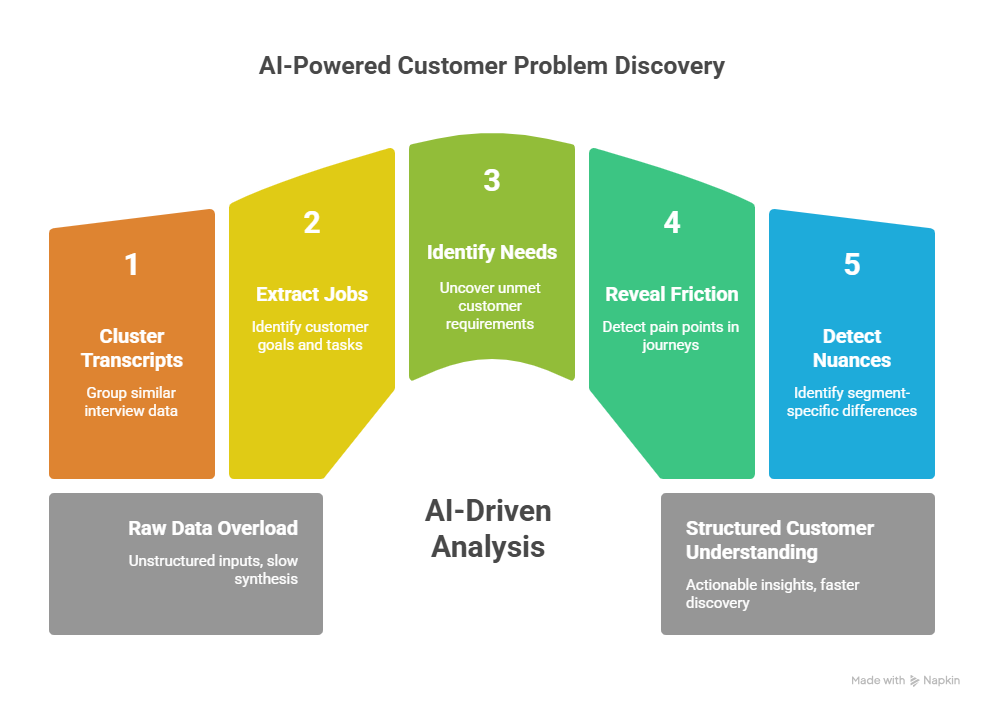
2. Convert Data Into Real Customer Problems
AI transforms raw inputs into structured understanding.
It can:
• Cluster interview transcripts
• Extract jobs-to-be-done
• Identify unmet needs across personas
• Reveal friction points across journeys
• Detect segment-specific nuances
What took six weeks of note synthesis is now achievable between meetings.
AI doesn’t replace discovery.
It elevates it, free from bias, fatigue, or selective attention.
3. Run Scenario Simulations Before You Commit
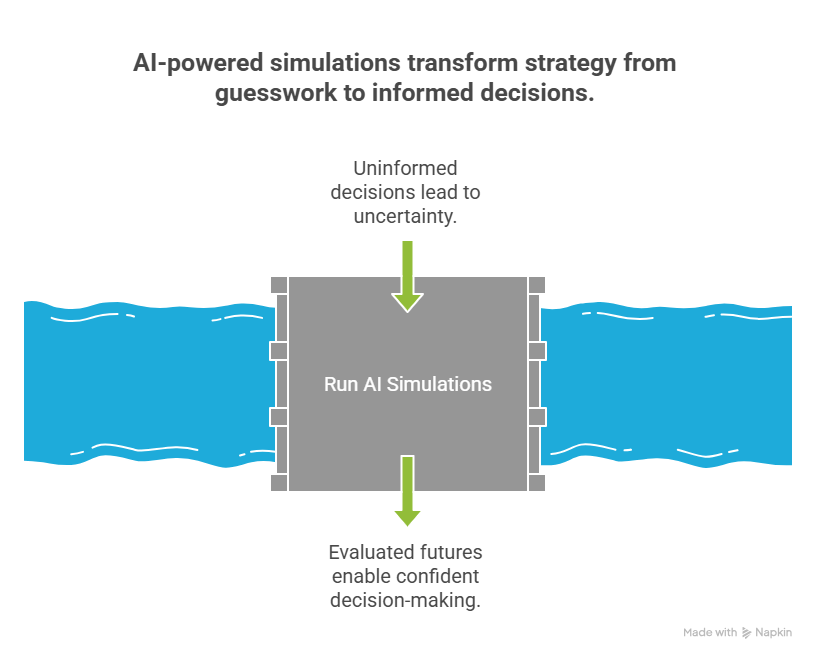
The most powerful shift AI brings to strategy is scenario modeling.
PMs can now simulate:
• Feature adoption likelihood
• Revenue impact across segments
• Operational cost and maintenance load
• Cannibalization risk
• Potential market backlash
• Time-to-value vs time-to-build
Suddenly, strategy isn’t guesswork.
It’s a portfolio of evaluated futures.
4. Let Your Strategy Become a Living System
The era of quarterly strategy decks is over.
Markets move too fast. Customers move even faster.
AI now acts as an always-on radar:
• Detecting competitor changes
• Monitoring usage shifts
• Re-running ROI models
• Recommending reprioritization
• Predicting metric movements before they drop
Your strategy evolves daily, because reality does too.
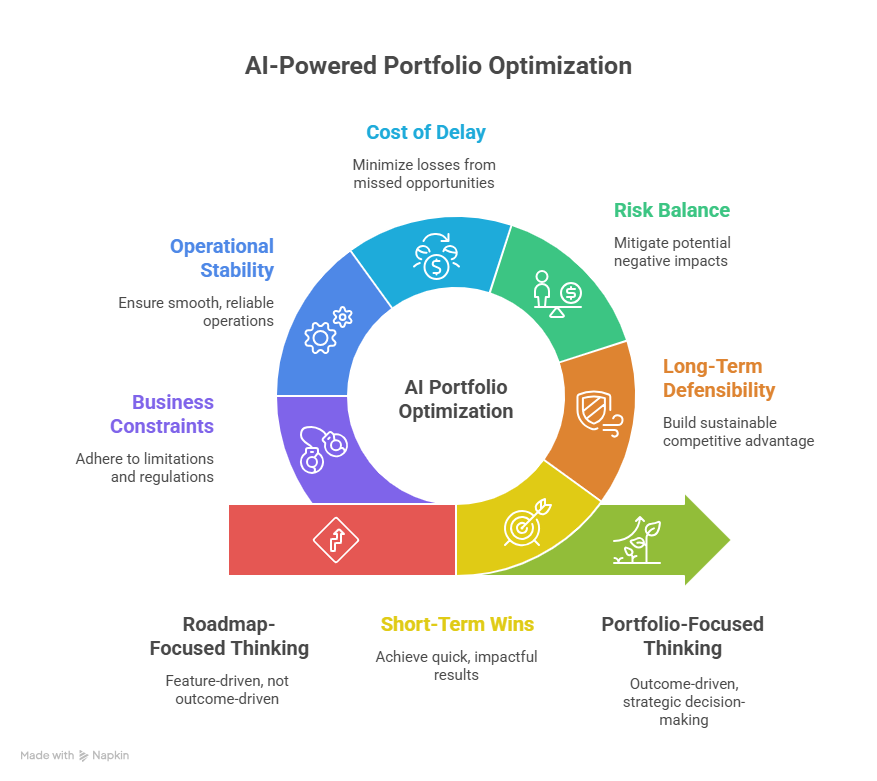
5. Move From Roadmaps to Portfolio Thinking
The best product leaders don’t ask, “What’s next on the roadmap?”
They ask, “What is the most effective combination of bets we can place right now?”
AI optimizes portfolios for:
• Short-term wins
• Long-term defensibility
• Risk balance
• Cost of delay
• Operational stability
• Business constraints
You stop thinking in features.
You start thinking in outcomes.
6. Prioritization That Reflects Real Context
Traditional scoring frameworks (RICE, MoSCoW) collapse under complexity.
AI-driven prioritization integrates real variables, and weights them dynamically:
• Market urgency
• Engineering feasibility
• Segment-level opportunity
• Competitive pressure
• User friction
• Strategic alignment
Prioritization becomes objective instead of political.
7. Automate Documentation and Refocus on Decisions
AI handles the creation of:
• PRDs
• User stories
• Acceptance criteria
• Solution design outlines
• Launch briefs
• Release notes
PMs report reclaiming 40–50% of their time, time that can be reinvested into thinking, shaping, and leading instead of formatting.
This is not efficiency.
It’s leverage.
8. Build Automatic Cross-Functional Alignment
Misalignment slows more product teams than bad ideas do.
AI becomes the unambiguous source of truth for:
• Engineers
• Designers
• Data teams
• Sales
• Leadership
It translates strategy into each team’s language, reducing escalations, clarifying dependencies, and accelerating execution.
Alignment stops being an effort.
It becomes the default.
9. Instrument What Actually Matters
AI now helps PMs see beyond dashboards and into the drivers of change:
• Which features actually move metrics
• What’s silently causing churn
• Where revenue is leaking
• Which user segments are at risk
• Which flows create disproportionate value
This transforms product analytics into strategic foresight.
The Real Impact: A Strategy That Compounds
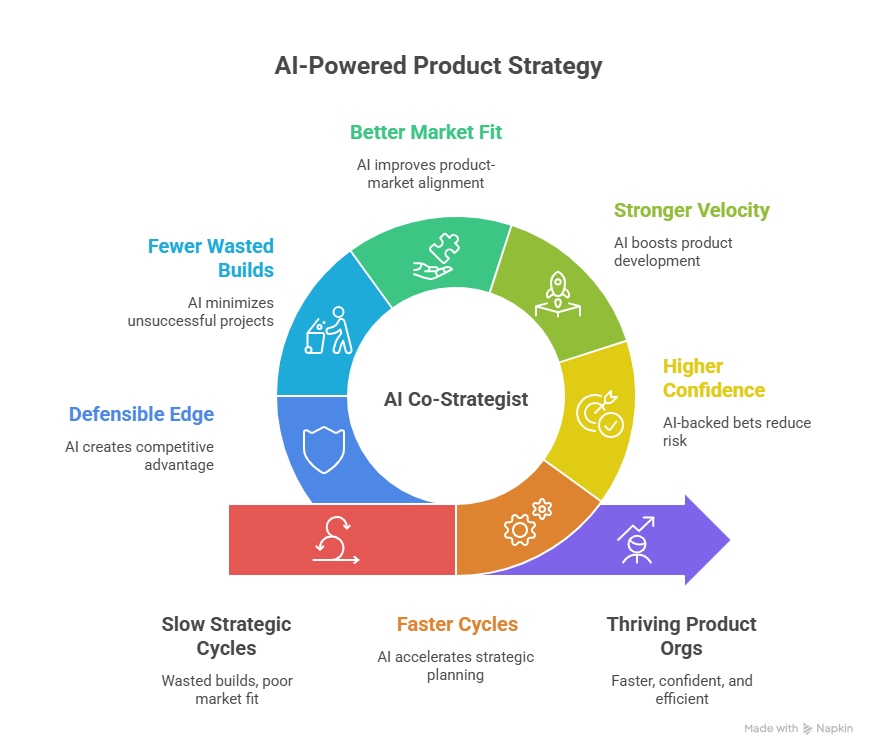
When AI becomes a co-strategist, product teams unlock:
• Faster strategic cycles
• Higher-confidence bets
• Stronger velocity
• Better market fit
• Fewer wasted builds
• A defensible competitive edge
This is what separates the 2026 product orgs that thrive from those that fall behind.
Product strategy used to be a function of experience.
Now, it’s a function of intelligence, human + machine.
And the PMs who master this shift will define the next decade.
.png&w=1200&q=75)