SQL for Product Managers
Reading Your First Query Without Fear
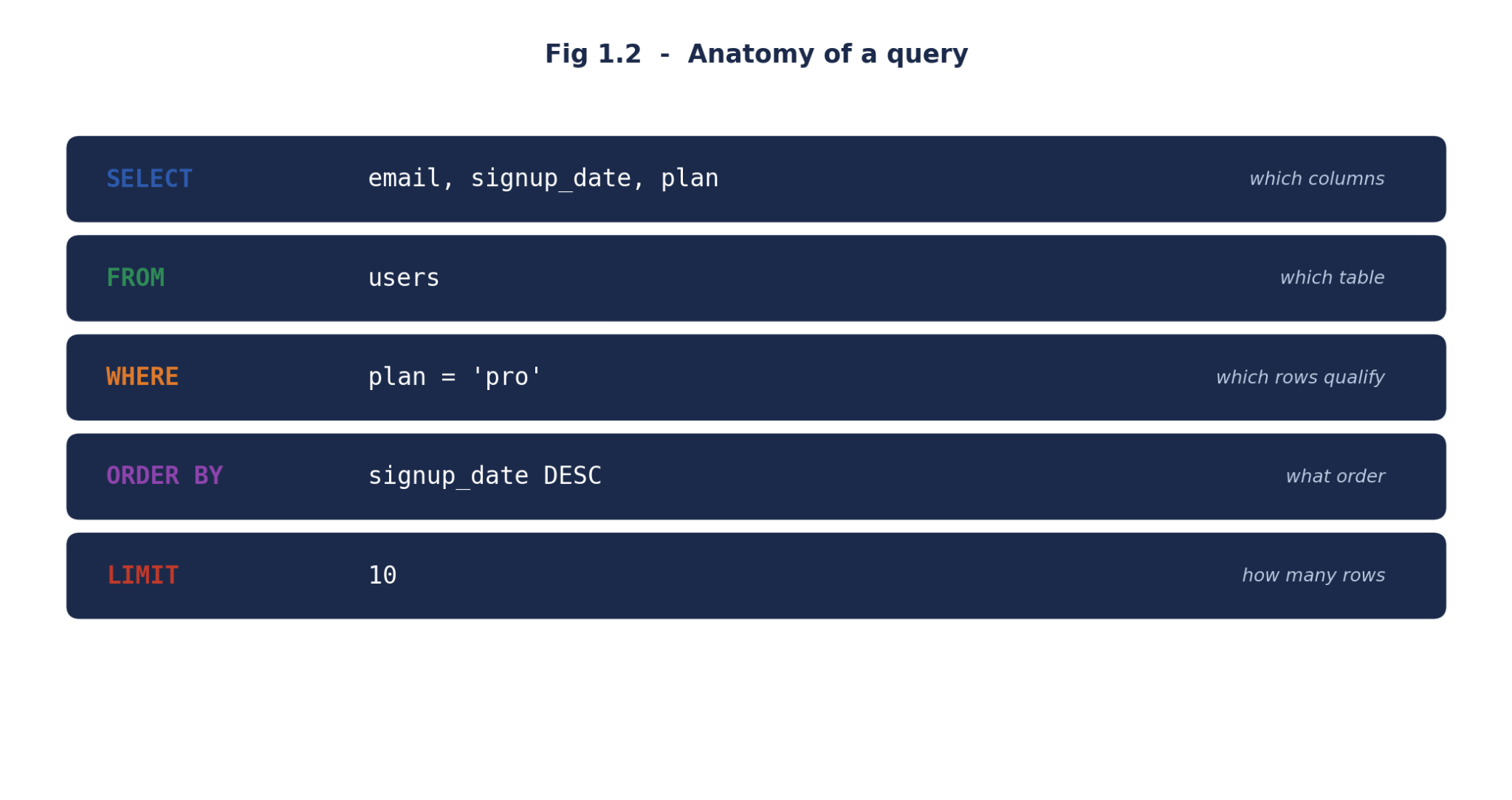
Every SQL query, no matter how long, is answering one of two questions: "show me these rows" or "show me a summary of these rows."
Here is a complete, real query:
SELECT email, signup_date, plan
FROM users
WHERE plan = 'pro'
ORDER BY signup_date DESC
LIMIT 10;
Read it out loud, left to right, and it says almost exactly what it looks like it says: "Show me the email, signup date, and plan, from the users table, where the plan is pro, ordered by signup date with the newest first, and give me only the first 10 rows."
Clause | Plain English | What happens if you remove it |
|---|---|---|
SELECT | Which columns do you want to see | Required. This is always your first decision: what am I actually looking at |
FROM | Which table are you asking | Required. Every query starts somewhere |
WHERE | Which rows qualify | Without it, you get every row in the table, filtered by nothing |
ORDER BY | What order should results come back in | Without it, order is not guaranteed, and "not guaranteed" really does mean unpredictable |
LIMIT | How many rows, maximum | Without it, you might get millions of rows back and crash your query tool |
That's it. That is the skeleton of nearly every query you will read or write as a PM. Everything else in this course is variation and combination on top of these five ideas.
YOUR MOVE THIS WEEK
Find one query already written by someone on your team, in a dashboard's underlying SQL, a saved report, anywhere. Before asking anyone what it does, try to read it yourself using the table above. Then check your interpretation against someone who knows. You will be more right than you expect.