Data for AI Products
Working with Data Science and ML Teams While Speaking Their Language Fluently
Learn twelve words properly. That is genuinely all it takes to change the quality of the conversation.
PMs fail in ML conversations in one of two ways. Either they nod along and lose control of the product, or they overcompensate, use terms they half-understand, and lose credibility permanently. The escape from both is narrow and achievable: know a small number of concepts precisely, and be openly, comfortably ignorant about everything else.
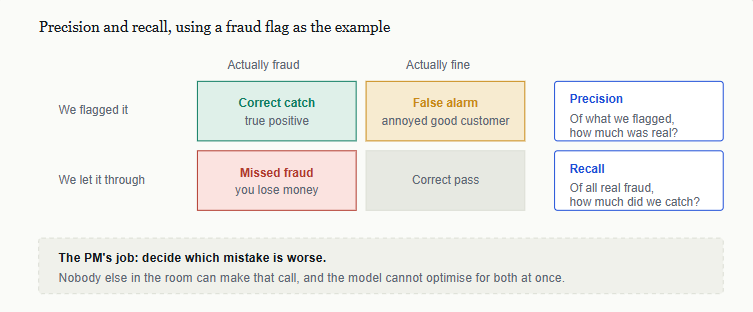
Start with the pair that causes the most expensive misunderstandings in product meetings.
Fig 4.1 - You will be asked to trade precision against recall. That is not a technical question dressed up as a product one. It is a product question, full stop.
Now the vocabulary. Learn these twelve and you will follow 90% of what is said in your ML standups.
| Term | What it means in plain English | Why you care |
|---|---|---|
| Precision | When we say yes, how often are we right | Low precision means annoyed users and lost trust |
| Recall | Of everything we should have caught, how much did we catch | Low recall means missed fraud, missed leads, missed harm |
| F1 | A single number blending precision and recall | Convenient, and it hides the trade-off you are supposed to be making. Ask for both numbers. |
| Baseline | The dumbest possible approach, scored | If your model does not clearly beat "always answer the most common class", you have nothing |
| Overfitting | The model memorised the training data instead of learning the pattern | Great offline scores, bad product. Classic cause of a demo that never becomes a feature. |
| Held-out / test set | Data the model has never seen | The only honest score you will get |
| Golden set | Hand-curated cases that define "good" for your business | Yours to own. This is your product spec in executable form. |
| Drift | Reality moved, the model did not | Your quietest, most reliable source of production failure |
| Embedding | Turning text into numbers so similar meanings sit close together | The engine under RAG. When retrieval fetches something irrelevant, this is usually where to look. |
| Chunking | Splitting documents into retrievable pieces | Bad chunking splits a policy in half and the model answers with the half that was wrong |
| Hallucination | A fluent, confident, false answer | Not a bug to be fixed once. A property to be bounded, measured, and disclosed. |
| Human in the loop | A person reviews or approves before the output reaches the customer | Frequently the difference between a launchable product and a legal problem |
Three sentences that will earn you more credibility than any amount of jargon:
• "What is the baseline, and by how much do we beat it?"
• "Show me ten failures, not the average score."
• "I do not follow that part. Can you explain it as if I were the customer?"
The third one is the most powerful, and PMs are afraid of it. They should not be. A senior engineer respects the person who admits the gap and asks. They lose respect for the person who nods and then makes a decision that reveals they did not understand.
YOUR MOVE THIS WEEK
In your next model review, ask to see the ten worst failures rather than the aggregate metric. Aggregate metrics tell you how the model did. Failures tell you what the model is, and that is the thing you are shipping.