Data for AI Products
Data Quality: What "Good Data" Actually Means
Six dimensions. Volume is not one of them.
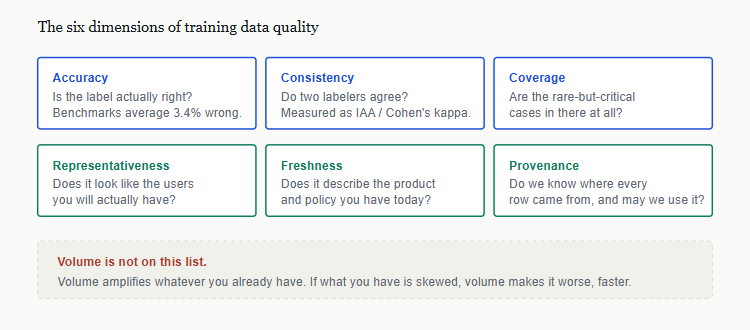
When a team says "we need better data", they almost always mean "we need more data", and those are different requests. More of the same skew makes the skew more confident. So let us define quality properly, in terms you can put in a requirements doc.
Fig 2.2 - Any requirements doc that specifies row counts but not these six dimensions is a wish, not a spec.
Two of these deserve a proper explanation because they are the ones that show up in real arguments.
Consistency is measured with inter-annotator agreement, often reported as Cohen's kappa. Kappa adjusts raw agreement for the agreement you would expect by chance. You do not need the formula. You need the interpretation, and you need to demand the number.
| Kappa | What it means | What you should do |
|---|---|---|
| Below 0.4 | Your labelers are essentially disagreeing | Stop. The task definition is broken, not the labels. Rewrite the guideline. |
| 0.4 to 0.6 | Moderate. Common for subjective tasks like tone or sentiment. | Acceptable if you know it, and if your product tolerates it. Adjudicate disagreements with a senior reviewer. |
| 0.6 to 0.8 | Good. A realistic target for most business tasks. | Proceed. Spot check 5% ongoing. |
| Above 0.8 | Strong agreement | Proceed, but check that the task is not trivially easy in a way that will not hold in production. |
Representativeness is the one that ends careers. The classic form: your training data is drawn entirely from the customers your old system served well, so the model learns to be excellent at the customers you already had and blind to the ones you want next. If you are a lending product and your historical approvals skew to salaried metro applicants, a model trained on that history will encode that skew and present it back to you as objectivity. Under India's DPDP framework, Significant Data Fiduciaries face obligations that include algorithmic fairness assessments, and the EU AI Act treats credit scoring and hiring as high-risk categories. This is no longer only an ethics conversation. It is a compliance conversation with dates attached.
THREE QUALITY BUGS THAT LOOK LIKE MODEL BUGS
Label leakage. A field in your data secretly contains the answer. Example: a refund_processed_date column in a model predicting refunds. Offline accuracy will be near perfect and production accuracy will be near zero. Distribution shift between train and prod. You trained on last year's tickets. This year you launched in three new markets and changed your pricing page. The model is answering questions about a product that no longer exists. Duplicate contamination. The same example appears in training and tests. Your score is inflated and nobody knows by how much.
YOUR MOVE THIS WEEK
Add one line to your feature's definition of done: "Inter-annotator agreement on the evaluation set is reported, and any label class below 0.6 kappa is re-specified before training." That single sentence, enforced, will prevent more failures than any model upgrade you will ever approve.