Lesson 1
Monetizing APIs: Four Models and When Each Works
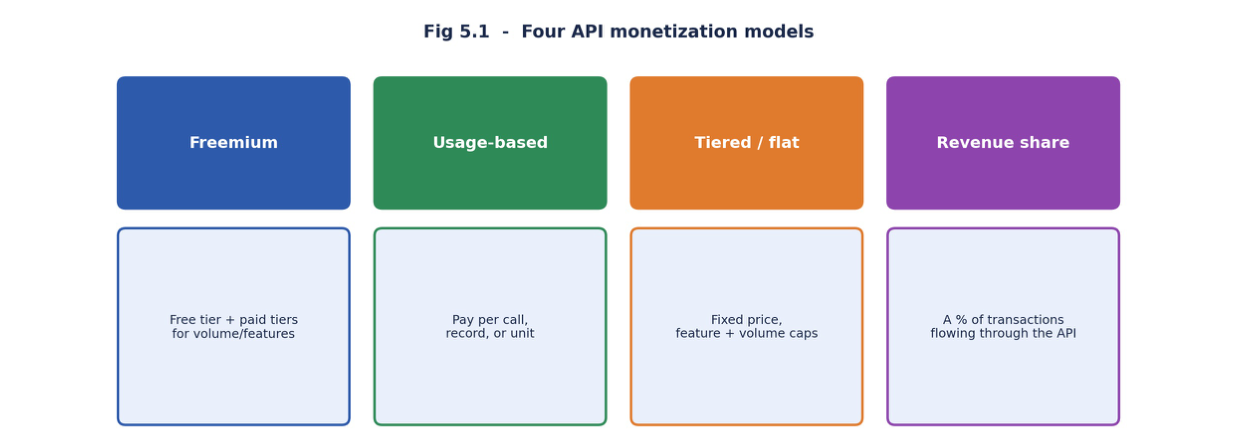
Fig 5.1 — Four API monetization models
Model | How it works | Works well when | Watch out for |
|---|---|---|---|
Freemium | Free tier with real limits, paid tiers unlock more volume or features | You're building a developer funnel and adoption matters more than early revenue | The free tier being too generous, killing conversion, or too stingy, killing adoption |
Usage-based | Pay per call, per record, or per unit of consumption | Costs scale predictably with usage, and customers can tie the cost to value received | Unpredictable bills scare enterprise buyers; needs clear cost calculators and alerts |
Tiered/flat | Fixed price per tier, with feature and volume caps | Buyers want budget predictability, especially enterprise procurement | Poorly chosen tier boundaries push customers to either under-buy and hit walls, or over-buy out of caution |
Revenue share / partnership | You take a percentage of transactions flowing through the API | The API enables a marketplace or payments flow where you can credibly claim a piece of the value created | Requires real trust and transparency in the underlying transaction data |
The decision isn't purely a pricing exercise — it's a signal about what behavior you want to encourage. Usage-based pricing rewards efficient integration and can feel punishing to a developer still prototyping. Flat tiers reward experimentation but can make you eat the cost of your heaviest users. Most mature API businesses land on a hybrid: a genuinely usable free tier to win developer mindshare, then usage-based or tiered pricing once real production traffic starts.
YOUR MOVE THIS WEEK
If your API has pricing, sketch what a developer's cost looks like at three usage levels: prototype, early production, and scaled production. If the jump between any two of those feels like a cliff instead of a ramp, that's your next pricing conversation.