Lesson 5
Where PMs Actually Sit in the API Lifecycle
You are not the architect. You are the person who defines what the API is for, and who it must never break for.
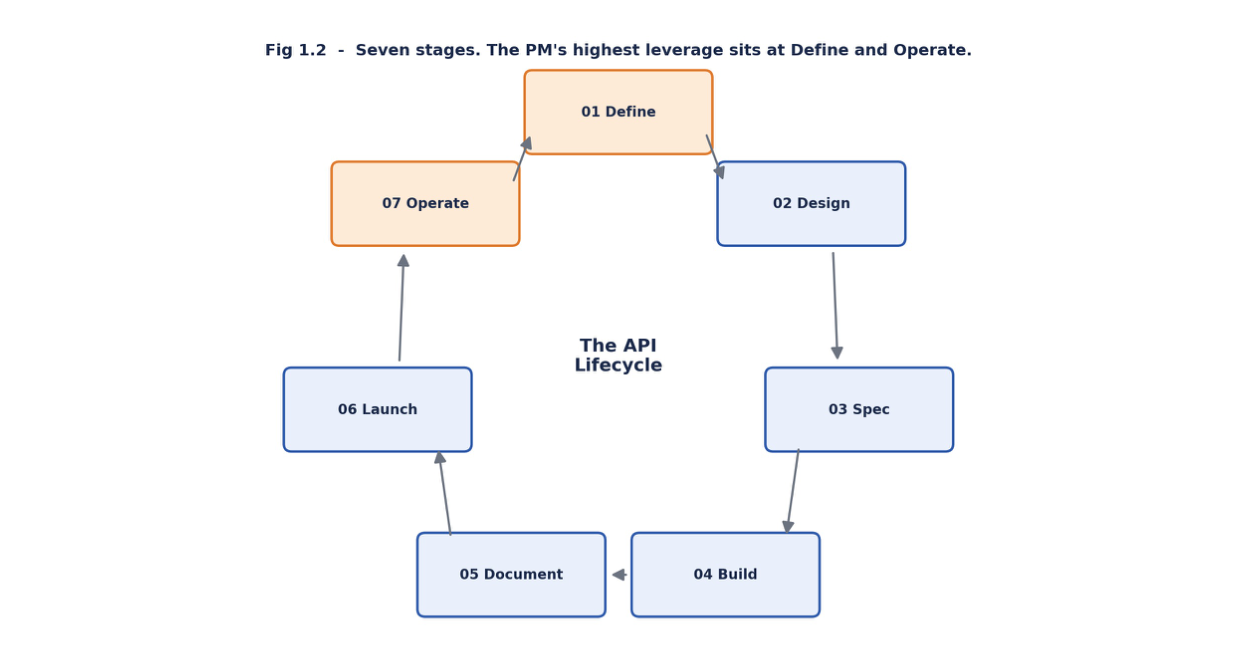
Fig 1.2 — Seven stages. The PM's highest leverage sits at Define and Operate.
Just as training data has a lifecycle a PM doesn't run but must steer, so does an API. Here's the version stripped to what you need.
Stage | What happens | The PM question that saves the project |
|---|---|---|
01 Define | Deciding what capability the API exposes and to whom | What is a caller actually trying to accomplish, and is this the smallest API that accomplishes it? |
02 Design | Naming resources, choosing methods, shaping responses, error handling | Would a developer who has never met us understand this without asking a question? |
03 Spec | Written down formally (usually as an OpenAPI document) | Does the spec match what we actually agreed to build, or did it drift during implementation? |
04 Build | Engineers implement it | Mostly not your stage — but you own the acceptance criteria they're building against |
05 Document | Guides, references, examples are written | Could a new developer make their first successful call using only this doc, with no Slack message to us? |
06 Launch | Beta, then general availability | What's our rollback plan if the first week reveals a bad decision? |
07 Operate | Monitoring, support, versioning, eventual deprecation | How will we know it's breaking someone before they tell us on Twitter? |
Two stages carry almost all of the PM's leverage: 01 Define and 07 Operate. Everything in between is where you collaborate, but those two bookends are where a PM who skips the work is invisible in the failure, and a PM who does the work is invisible in the success — which, in this discipline, is the correct kind of invisible.
FIELD NOTE
A useful test: could you, right now, name the single most important caller of your API and describe, in one sentence, the one thing that must never change for them? If you can't, you don't have a product decision recorded anywhere — you have an accident waiting to happen, and it will happen exactly when that caller matters most.
YOUR MOVE THIS WEEK
Draw the seven stages for one API you own or influence. Write a name next to each one — who actually owns that stage today. If Define or Operate has no name next to it, that's this week's real finding.