


A Practical Guide to Choosing AI Chatbots for Real Work
For the last two years, the AI conversation has been dominated by one question:
“Whose model is bigger and smarter?”
By early 2026, that question is quietly being replaced by a more uncomfortable and more revealing one:
“Whose AI actually gets used?”
The renewed “chatbot wars” across consumer assistants and enterprise platforms are not really about intelligence anymore. They’re about distribution, integration, and habit formation.
This shift explains why competition has intensified around chatbots and what organizations should actually look for when choosing one.
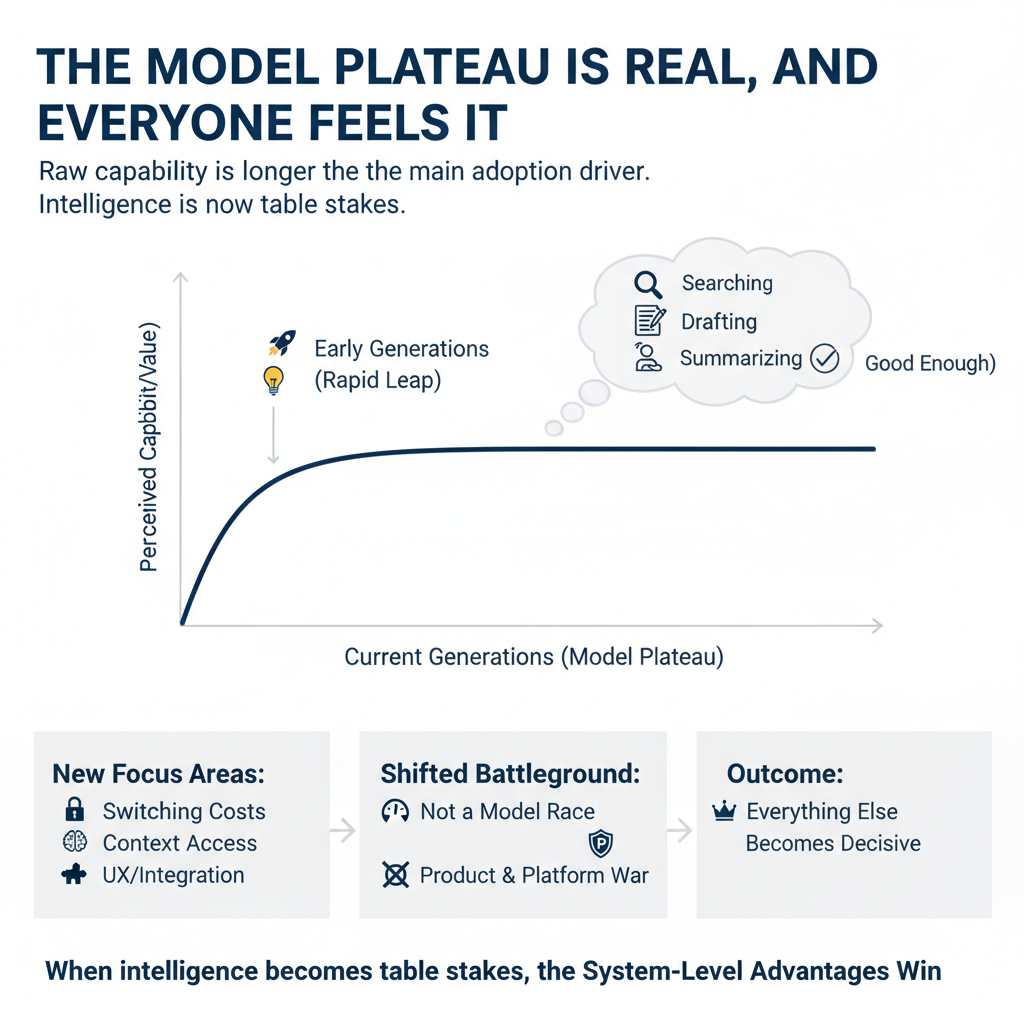
The Model Plateau Is Real, and Everyone Feels It
Large language models continue to improve, but for most users, the perceived leap between generations has flattened.
For everyday work, summarising, drafting, searching, and reasoning, many assistants now feel “good enough.”
As a result:
- Raw capability is no longer the main adoption driver
- Switching costs matter more than benchmark scores
- Context access beats marginal accuracy gains
When intelligence becomes table stakes, everything else becomes decisive.
This is why the chatbot wars have reignited, not as a model race, but as a product and platform war.
The New Battlefield: Where the Chatbot Lives
In 2026, the most important question isn’t how smart the chatbot is.
It’s where it shows up and what it can do there.
Competition is now happening across three fronts.
1. Workplace Embedding
Assistants embedded inside:
- documents
- code editors
- CRM systems
- project management tools
gain daily usage by default.
They don’t need to be “opened.”
They’re already there.
2. Context Depth
The stickiest chatbots are not general-purpose.
They understand:
- organizational data
- historical decisions
- permissions and roles
- internal workflows
Context isn’t just memory; it’s institutional awareness.
3. Actionability
Winning assistants don’t just answer questions.
They:
- create tickets
- update records
- trigger workflows
- coordinate across tools
This is the line between assistive AI and productive AI.

Why Enterprise Adoption Is the Real Signal
Consumer chatbot usage is noisy:
- people experiment
- novelty spikes
- usage churns
Enterprise adoption is slower but far more honest.
What organizations actually care about now:
- security and data boundaries
- reliability and latency
- auditability
- governance and human oversight
- integration with existing systems
An assistant that demos well but can’t be governed rarely survives beyond pilots.
That’s why “enterprise bots battling for users” isn’t about marketing.
It’s about trust at scale.
Why Enterprise Adoption Is the Real Signal
Consumer chatbot usage is noisy:
- people experiment
- novelty spikes
- usage churns
Enterprise adoption is slower but far more honest.
What organizations actually care about now:
- security and data boundaries
- reliability and latency
- auditability
- governance and human oversight
- integration with existing systems
An assistant who demos well but can’t be governed rarely survives beyond pilots.
That’s why “enterprise bots battling for users” isn’t about marketing.
It’s about trust at scale.
Funding and Valuations Are Following Integration - Not Intelligence
Investment patterns reinforce this shift:
- Platform-layer AI companies attract more durable valuations
- Workflow-native AI tools outperform standalone assistants
- Products that reduce tool sprawl outperform those that add new interfaces
In simple terms:
AI value is being priced on how embedded it becomes, not how impressive it sounds.
The Quiet Lesson of the Chatbot Wars
The biggest insight from this renewed competition is simple:
AI does not win by being smarter in isolation.
It wins by becoming unavoidable in daily work.
That’s why, in 2026:
- integration beats innovation theater
- reliability beats novelty
- adoption beats benchmarks
AI advantage is no longer a model problem.
It’s a systems, design, and governance problem.
How to Evaluate and Choose AI Chatbots for Business Workflows (2026 Edition)
Choosing an AI chatbot today is less about features, and more about fit.
Here’s how serious teams are evaluating assistants now.
1. Start With the Workflow, Not the Model
Ask first:
- What decisions does this assistant support?
- What systems does it need to touch?
- Who relies on its outputs?
If the chatbot doesn’t map cleanly to real workflows, adoption will stall, no matter how advanced the model is.
2. Evaluate Context Access (Carefully)
Key questions:
- What data can it see?
- How fresh is that data?
- How are permissions handled?
- Can access be scoped and audited?
More context is powerful, but only when it’s controlled and explainable.
3. Assess Actionability
Strong assistants:
- update records
- trigger workflows
- coordinate tasks
Weak assistants:
- generate text you still have to copy-paste
The productivity difference becomes obvious within weeks.
4. Test Governance and Human Oversight
Look for:
- clear decision ownership
- explainable outputs
- review checkpoints
- override mechanisms
If “the system decided” becomes common language, that’s a warning sign, not progress.
5. Measure Adoption, Not Satisfaction
Early pilots often feel successful.
Better signals are:
- repeat usage
- fewer handoffs
- faster cycles without quality loss
- reduced shadow tooling
Adoption tells the truth that demos don’t.
6. Plan for Lock-In (Honestly)
Every embedded assistant creates switching costs.
Ask:
- How portable is our data?
- Can workflows survive tool changes?
- Are we building dependency, or leverage?
Responsible AI choice includes an exit strategy.
Final Thought
The chatbot wars of 2026 are not about who has the smartest AI.
They’re about:
- who integrates best
- who earns trust
- who fits real work
Choose accordingly.
.png&w=1200&q=75)