Product discovery is a critical process in product management that helps teams create products that truly resonate with users and drive business value.
This guide will walk you through the essential components of effective product discovery, providing practical techniques and insights you can apply immediately.
What is Product Discovery?
Product discovery is the process of identifying and validating user problems, exploring potential solutions, and ensuring that the product aligns with user needs and business goals. It's about minimizing risks by learning early what works and what doesn't before committing significant resources to product development.
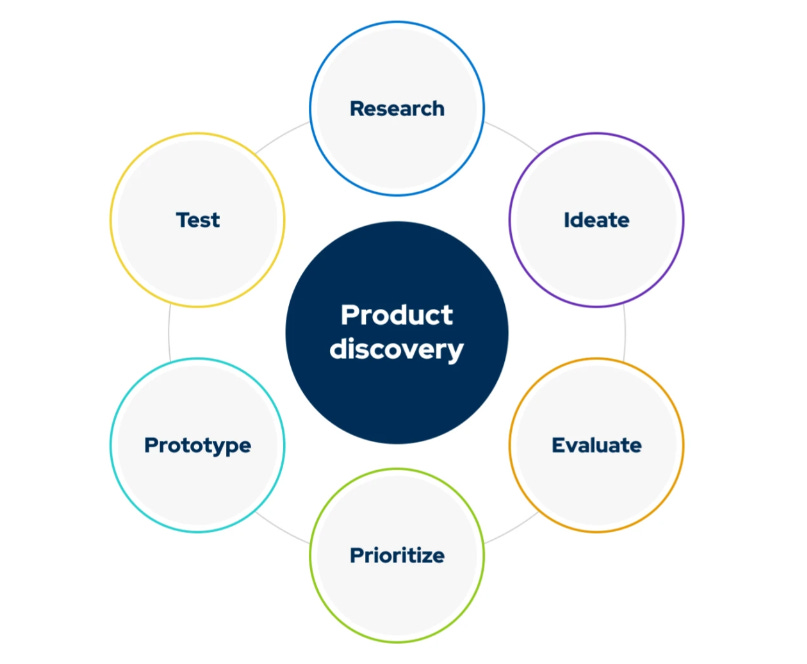
source: aharoadmaps
The primary objectives are to:
- Understand user needs deeply
- Identify valuable problems to solve
- Explore potential solutions
- Validate assumptions and reduce risk
Effective product discovery leads to better product-market fit, reduced waste in development, and increased chances of product success.
The Product Discovery Process
There are 5 main stages in product discovery process. We will explore each of them in detail and provide actionable insights for you to practically implement them in your product discovery process.
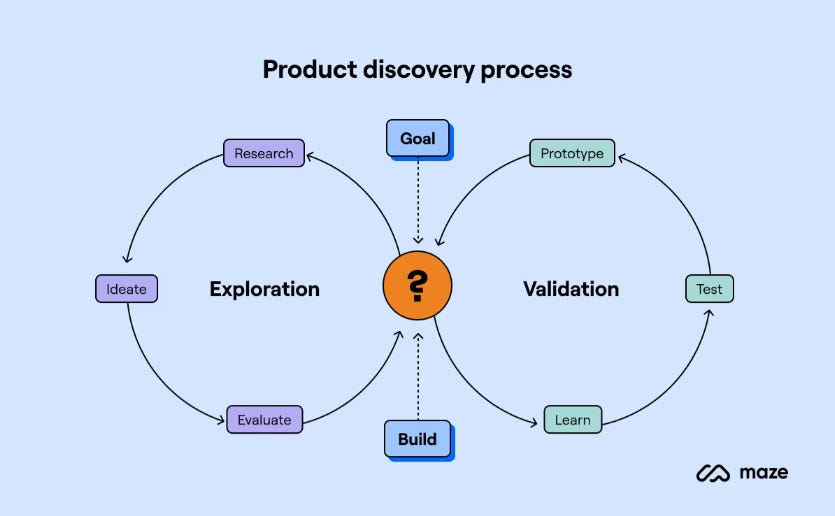
source: maze
1. Problem Space Exploration
The foundation of product discovery is a deep understanding of the problem space. This involves identifying and validating the real problems users face, ensuring that the solutions you develop are both relevant and impactful. Here are practical techniques to identify and validate problems:
a) Customer interviews:
Conduct open-ended interviews with potential customers to gather qualitative insights. These encourage detailed responses and help uncover underlying issues that structured questions might miss.
Use the "5 Whys" technique to drill down into the root cause of a problem. For instance, if a user says they are frustrated with a feature, ask "why" repeatedly to understand the deeper issue behind their frustration.
Focus on user context, goals, and frustrations or pain points they encounter. This holistic view can reveal insights that are critical for developing effective solutions.
b) Observation techniques:
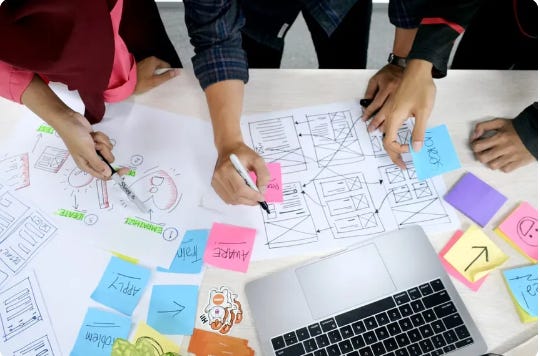
Conduct field studies, observe users in their natural environment to see how they interact with your product or similar solutions. Field studies can provide context that interviews alone might miss, such as environmental factors or habitual behaviors.
For digital products, use screen recordings or session replays. There are tools that record user sessions can help you see exactly how users navigate your product. Look for points of friction, drop-offs, or repeated actions that indicate confusion or inefficiency.
Pay attention to the workarounds users create to overcome limitations. These can signal areas where your product is falling short and opportunities for improvement.
c) Data analysis:
Analyze user behavior data. Use analytics tools to track how users interact with your product. Look for patterns, such as which features are most or least used, and where users spend the most time.
Review customer support tickets and feature requests. These are gold mines for understanding user problems. Look for common issues and recurring themes that suggest areas for improvement.
Use cohort analysis. Segment users based on behavior, demographics, or other criteria to identify specific groups facing unique problems. This can help tailor solutions to different user needs and improve overall satisfaction.
d) Creating problem statements:
Synthesize findings into clear, actionable problem statements. Combine insights from interviews, observations, and data analysis to create concise problem statements. These should clearly articulate the user's need and the context behind it.
Use the problem statement format. For example, a useful format for problem statements is: "[User] needs a way to [user's goal], because [insight]." This structure helps ensure that the problem is user-centric and grounded in real insights.
Not all problems are equally important. Prioritize based on factors such as the frequency of the problem, its severity, and its potential impact on the business. Focus on solving the most critical issues first to deliver the most value.
2. Ideation and Solution Exploration
Once key problems have been identified and validated, the next step is to explore potential solutions. This involves generating ideas, prioritizing them, and ensuring they align with both user needs and business goals. Here are practical techniques for each stage:
a) Idea generation methods:
Organize structured brainstorming sessions with team members from diverse backgrounds and roles. This diversity fosters a wide range of perspectives and ideas, leading to more innovative solutions.
Use Techniques Like Brainwriting or SCAMPER:
- Brainwriting: In this method, participants write down their ideas and pass them to the next person, who builds on them. This reduces the pressure of thinking on the spot and allows for more thoughtful contributions.
- SCAMPER: This technique involves prompting creativity by asking questions about Substituting, Combining, Adapting, Modifying, Putting to another use, Eliminating, and Reversing aspects of existing solutions or ideas.
Start by encouraging outlandish and unconventional ideas. This helps break free from traditional thinking patterns and can lead to breakthrough innovations. Once the creative energy is flowing, you can refine and evaluate these ideas more critically.
b) Prioritization techniques:
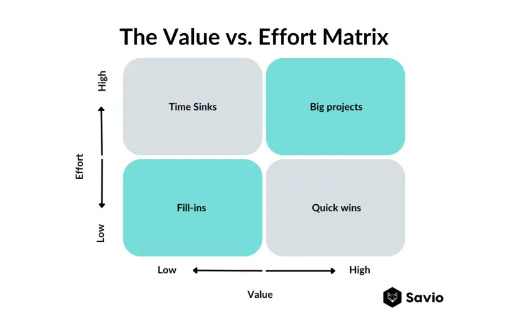
Use the Impact vs. Effort Matrix. Quickly evaluate ideas by plotting them on a matrix that compares their potential impact against the effort required to implement them. This helps identify quick wins (high impact, low effort) and avoid low-value, high-effort initiatives.
Conduct a Weighted Scoring exercise. Assign scores to ideas based on key criteria such as user value, business value, and feasibility. Weight these criteria according to their importance to ensure that the most valuable ideas rise to the top.
You might also consider using the Kano Model if required. It helps categorize features based on how they impact user satisfaction. Features can be classified as basic needs, performance needs, or delighters. This helps prioritize features that are essential or have the potential to significantly enhance user satisfaction.
source: savio
c) Mapping ideas to user needs and business goals:
Create a value proposition canvas for each potential solution, to clearly articulate the benefits it offers to users and how it addresses their pain points. This ensures that solutions are aligned with user needs.
Use the Jobs-to-be-Done (JTBD) Framework. It focuses on understanding the underlying jobs users are trying to get done. By framing solutions in terms of the jobs they accomplish for users, you can ensure they are closely aligned with real user needs and contexts.
Conduct a business model canvas exercise to validate the business viability of each potential solution. This helps ensure that the solution is not only desirable for users but also viable and feasible from a business perspective.
3. Prototyping and Testing
Quickly bringing ideas to life and testing them with users is crucial for validating solutions and refining them before full-scale development. Here’s how to structure that:
a) Rapid prototyping methods:
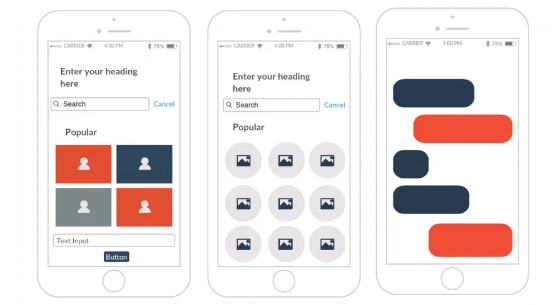
Begin with simple, low-fidelity prototypes such as paper sketches or wireframes. These are quick and inexpensive to create, allowing you to explore different ideas and iterate rapidly without significant investment.
For more detailed and interactive prototypes, leverage design tools such as Figma, Balsamiq, or Adobe XD. These tools enable you to create clickable prototypes that simulate user interactions, providing a more realistic experience for user testing.
When a higher level of functionality is needed, you might even consider using no-code tools like Webflow or Bubble to build functional prototypes. These tools allow you to create working models of your ideas without requiring extensive coding, making it easier to test complex interactions and workflows.
source:creately
b) User testing approaches:
Conduct moderated usability tests, where a facilitator guides users through the prototype and observes their interactions. These can be conducted in-person or remotely via video conferencing tools. Moderated tests allow for real-time observation and immediate probing into user behaviors and thoughts.
For quick and large-scale feedback, you can employ unmoderated testing platforms like UserTesting or Maze. These platforms allow users to interact with the prototype on their own time, providing insights from a larger pool of participants without the need for a facilitator.
To evaluate and refine the information architecture of your product, use card sorting or tree testing techniques. Card sorting helps understand how users categorize information, while tree testing evaluates the effectiveness of your navigation structure by asking users to find specific information.
c) Gathering and analyzing feedback:
Collect a mix of quantitative data (e.g., task completion rates, time on task) and qualitative data (e.g., think-aloud protocols, open-ended feedback). This combination provides a comprehensive understanding of user interactions and perceptions.
Analyze the data to identify recurring patterns and themes in user behavior and feedback. Look for common pain points, confusion, and areas where users struggle, as these are key opportunities for improvement.
Identify critical usability issues and areas for improvement. Prioritize the most critical usability issues based on their impact on the user experience and focus on addressing these issues first to significantly enhance the overall usability and effectiveness of your product.
4. Validation and Decision Making
Transitioning from assumptions to evidence-based decisions is crucial in product development. This phase involves defining success metrics, running experiments, and making informed decisions based on data. Here are practical techniques for each stage:
a) Defining success metrics:
Set SMART (specific, measurable, achievable, relevant & time-bound) goals for your product or feature. These goals should be clearly defined so that you can objectively assess whether they have been achieved. For example, a goal could be to ‘increase user engagement by 20% within three months’.
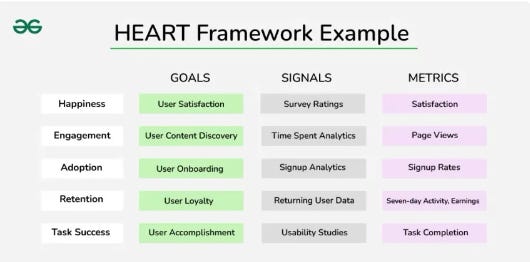
Use the HEART framework: It’s a comprehensive approach to measuring user experience across five dimensions:
- Happiness: User satisfaction and perceived quality.
- Engagement: Frequency and depth of user interactions.
- Adoption: The rate at which new users adopt the product or feature.
- Retention: The ability to keep users returning over time.
- Task Success: Efficiency and effectiveness in completing key tasks.
source:geeksforgeeks
Ensure that your success metrics align with broader business goals. For example, if the business objective is to increase revenue, your product metrics might focus on conversion rates and customer lifetime value (CLTV).
b) Running experiments:
Design A/B Tests. It involves comparing two versions of a product or feature to see which performs better. Randomly assign users to each version and measure their behavior to determine which variant achieves the desired outcome.
Use Fake Door Tests. It helps you gauge interest in a new feature by presenting it to users before it’s fully developed. For example, you might add a button or link for the feature and track how many users click on it. This helps validate interest before investing significant resources.
For more complex features, conduct limited rollouts or beta tests. Release the feature to a small, representative group of users and gather feedback before a full launch. This approach helps identify and address issues early.
c) Making data-driven decisions:
Use a mix of quantitative data (e.g., metrics and analytics) and qualitative insights (e.g., user feedback and interviews) to make well-rounded decisions. Quantitative data provides scale, while qualitative data offers depth and context.
Make sure that the results of your experiments are statistically significant before making decisions. This means that the observed effects are likely not due to random chance, providing confidence in the validity of the findings.
Not all ideas will succeed. Be prepared to discontinue features or initiatives that fail to meet predefined success criteria, even if significant effort has been invested. This discipline ensures that resources are focused on the most promising opportunities.
5. Iterative Refinement
Product discovery is an ongoing process that involves continuously incorporating learning, practicing continuous discovery, and balancing discovery with delivery.
a) Incorporating learnings:
Maintain a detailed learning record of insights and decisions made during the product discovery process. This log should include key findings from user research, testing, and experiments. It serves as a valuable reference for the team and helps ensure that learnings are not lost over time.
Regularly update your product roadmap based on new insights from discovery activities. This ensures that the roadmap remains aligned with user needs and business objectives, and reflects the most current understanding of priorities and opportunities.
Communicate findings and updates with stakeholders regularly. This keeps everyone informed and aligned, fostering a shared understanding of the product’s direction and the rationale behind decisions.
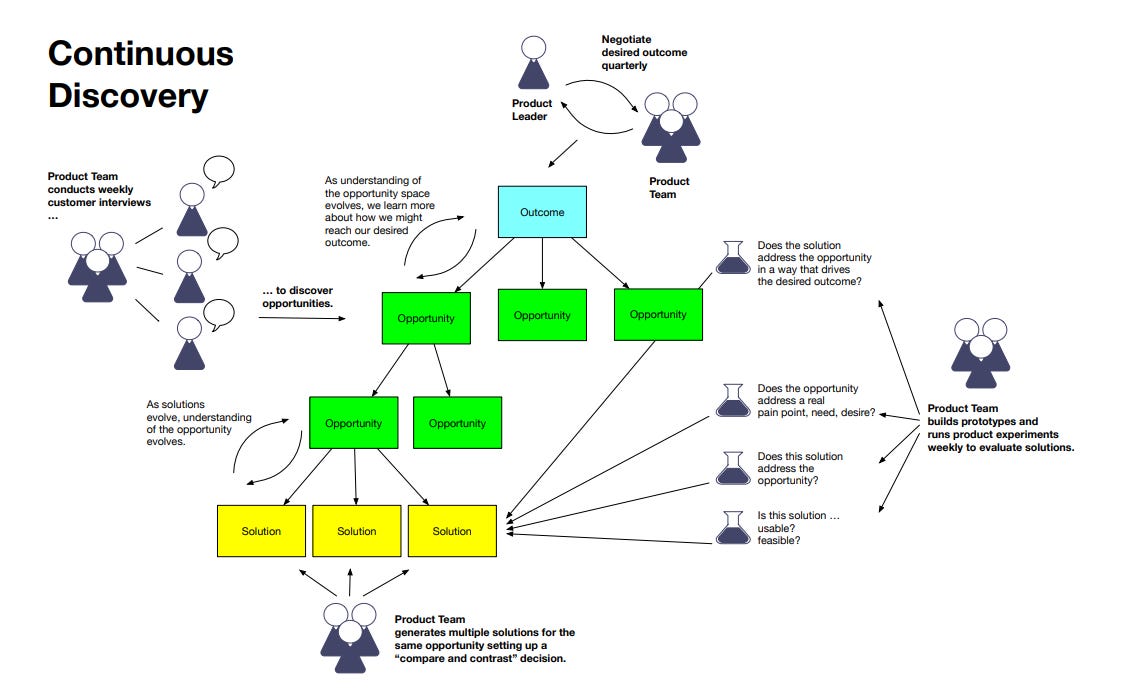
b) Continuous discovery practices:
Schedule regular customer interviews and usability tests. Make it a habit to engage with users frequently through interviews and usability tests. Regular interactions with users help keep the team attuned to their needs and pain points, and provide ongoing opportunities for gathering feedback and validating assumptions.
Set up systems to continuously monitor user behavior, analytics, and feedback. This allows you to quickly identify emerging trends, issues, and opportunities, and respond proactively.
Encourage a mindset of curiosity and experimentation within your team. Promote the idea that every assumption should be tested and validated, and create an environment where team members feel safe to explore new ideas and take calculated risks.
source: producttalks
c) Balancing discovery with delivery:
Ensure that time is explicitly set aside for discovery work. This might involve dedicating certain days or weeks to discovery activities or ensuring that a portion of each team member’s time is reserved for these tasks.
Integrate discovery tasks into your development sprints to maintain a balance between exploration and execution. This helps ensure that discovery work is not sidelined and that insights are continuously feeding into the development process.
Implement dual-track agile to parallelize discovery and delivery work. In this approach, one track focuses on discovery (identifying and validating problems and solutions) while the other focuses on delivery (building and releasing features). This allows for continuous iteration and refinement without delaying development progress.
Key Takeaways for Product Managers:
- Deepen user understanding through in-depth research and contextual analysis.
- Master problem identification by utilizing structured techniques and clear problem statements.
- Foster a culture of creativity and innovation by encouraging diverse perspectives and bold ideas.
- Prioritize with precision using frameworks like impact vs. effort and user satisfaction models.
- Accelerate testing through rapid prototyping and comprehensive user feedback.
- Integrate discovery and delivery through dual-track agile and dedicated discovery time.
- Cultivate a culture of experimentation by encouraging risk-taking and a mindset of continuous improvement.