The term "Design Thinking" initially might seem like a concept relevant only for designers, but it's a core competency for product managers as well aiming to create user-centric solutions.
The concept has roots in various fields, including engineering, architecture, and cognitive science. Its application in business and product development gained prominence in the late 20th century, particularly through the work of IDEO and Stanford's D. school.
What is Design Thinking?
Design Thinking is a user-centric approach to problem-solving that emphasizes empathy, creativity, and iterative testing. It is grounded in understanding the needs of the users, challenging assumptions, redefining problems, and creating innovative solutions to prototype and test. The core principles include empathy, collaboration, iteration and user-centricity.
For product managers, Design Thinking provides a structured yet flexible approach to understanding user needs and driving innovation. It allows product teams to create solutions that are not only functional but also desirable and feasible. By integrating Design Thinking into product management, you can ensure that your products resonate with users, address real pain points, and stand out in the market.
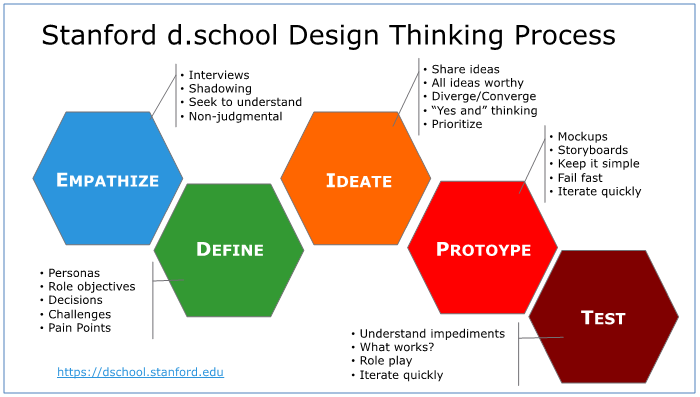
image source: Stanford d. school
The Five Stages of Design Thinking
This is a highly influential model created by Stanford D. School, one of the most well-known institutions for Design Thinking. This framework is divided into five stages:
1. Empathize with users
The first stage is about gaining a deep understanding of the users. Here you need to put aside preconceived notions and immerse yourself in the user's environment to gain deep insights into their needs, wants, behaviors, and pain points.
Techniques for gathering user insights:
- User interviews: One-on-one conversations to understand user perspectives
- Surveys: Collect quantitative data from a larger audience
- Observation: Watch users interact with products in their natural environment
Creating user personas and empathy maps helps synthesize this information. A user persona is a fictional character representing different user types, helping teams keep the user in mind throughout the design process, while an empathy map is a visual tools that explore what users say, think, feel, and do, to give a deeper understanding of their needs.
2. Define
After gathering user insights, the next step is to organize and make sense of the data. This involves identifying patterns, clustering similar insights, and determining the most pressing user needs.
A well-crafted problem statement is crucial as it guides the entire design process. It should be user-centered, focusing on the user’s needs rather than the company’s objectives. An example might be, "How might we create a more intuitive onboarding experience for first-time users?"
This stage also involves pinpointing key areas where the product can add value. It’s about finding the intersection between user needs and business objectives, ensuring that the solutions developed will be impactful and feasible.
3. Ideate
Ideation is about generating a wide range of creative solutions. It's important to defer judgment at this stage to encourage wild ideas.
Brainstorming techniques include:
- Divergent Thinking approach encourages expanding the solution space to generate as many ideas as possible. The aim is to push the boundaries of what’s considered feasible, encouraging creativity and innovation.
- Convergent Thinking helps narrow down these ideas to those that are most feasible and impactful. This stage involves critical evaluation and selection, focusing on practicality and alignment with the project’s goals.
- Reverse brainstorming involves identifying ways to cause or exacerbate the problem. By thinking about how to create problems, you can often uncover hidden issues and generate unique solutions that might not emerge through conventional methods.
Tools like mind mapping or the SCAMPER technique can help stimulate creative thinking.
- Mind Mapping: Visualizing connections between ideas to explore them further. It starts with a central idea and branches out into related thoughts, helping to organize and structure ideas in a way that makes it easier to see relationships and potential combinations.
- SCAMPER: It is a set of strategies used to think creatively about a problem. The technique involves substituting, combining, adapting, modifying, putting to another use, eliminating, and rearranging parts of the problem to spark new ideas.
4. Prototype
Prototyping is the process of creating simplified versions of your product to validate concepts and gather user feedback. These prototypes can range in fidelity, depending on the level of detail and interaction needed.
- Low-Fidelity Prototypes: These are basic representations, such as sketches or paper models, that allow you to visualize and test ideas quickly and inexpensively. They’re ideal for early-stage exploration, where the focus is on understanding the general concept rather than fine details.
- High-Fidelity Prototypes: These are more detailed, often digital, models that closely mimic the final product. They are interactive and allow for more realistic testing of the user experience. High-fidelity prototypes are typically used in later stages to refine specific features and interactions.
Rapid prototyping enables quick iteration, allowing you to refine your ideas based on real user feedback. Depending on the stage and needs, you can use a variety of tools:
- Sketch and Figma are popular digital tools for creating both low and high-fidelity prototypes. They allow for easy adjustments and collaboration among team members.
- Paper and Pencil are excellent for low-fidelity prototyping, offering flexibility and speed when exploring initial ideas.
Additional techniques include:
- Wireframing: This involves creating a basic visual guide of the product's layout, focusing on structure and functionality rather than design details. It helps establish the foundational elements of the product before moving into more detailed design work.
- Storyboarding: This technique involves visualizing the user’s interaction with the product through a series of frames or scenes. It’s a step-by-step representation of the user journey, helping to identify potential pain points or areas of improvement in the flow of the product.
5. Test
Testing is the crucial phase where you present your prototype to real users to gather valuable feedback. This can be done through various methods, such as usability testing, A/B testing, or beta releases.
- Usability Testing: In this approach, you observe how real users interact with the prototype, aiming to identify any usability issues or points of confusion. This method helps you understand whether the product is intuitive and easy to use.
- A/B Testing: This involves comparing two different versions of a product to determine which one better meets user needs. It’s a data-driven way to validate design choices and optimize user experience.
The key to effective testing is maintaining an open mind and a willingness to learn from the results. Embrace failures during testing as they offer critical insights for improving the product. Collecting and analyzing user feedback is essential to refine the prototype, ensuring the final product is both user-friendly and effective.
Design Thinking is an iterative process. Based on the feedback received, your product may need to go through multiple rounds of prototyping and testing before it reaches its final form. Each iteration brings you closer to a solution that truly resonates with users.
Integrating Design Thinking into Product Management
Design Thinking should be woven into the fabric of the product development process. It's particularly valuable in the product discovery phase, helping to ensure you're building the right product before you start building the product right.
Balancing user needs with business goals is crucial. While Design Thinking emphasizes user needs, PMs must also consider business viability and technical feasibility. The sweet spot lies at the intersection of these three factors.
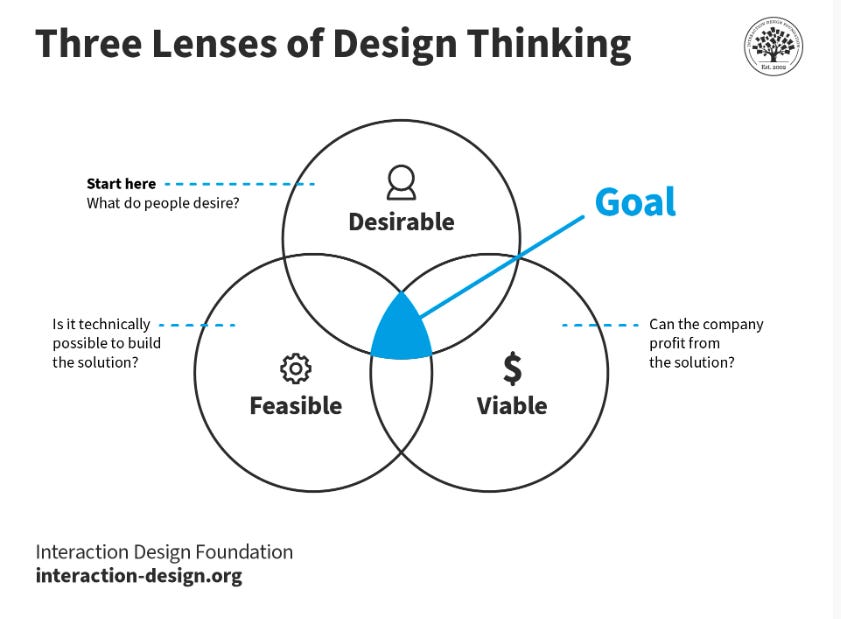
image source: IDEO
Design Thinking Tools and Techniques for PMs
Journey Mapping:
Journey mapping is a technique used to visualize the entire experience a user has with a product, from the first interaction to the last. It helps identify the user’s goals, actions, and emotions at each stage of their journey, pinpointing pain points where they may struggle or become frustrated.
This technique also reveals opportunities for improvement, allowing teams to enhance the overall user experience by addressing these challenges. Journey maps often include touchpoints, which are the specific interactions a user has with the product, and they help in understanding the user's needs more deeply.
Affinity Diagramming:
Affinity diagramming is a collaborative technique used to organize a large amount of data into meaningful groups or themes. After gathering insights from user research, brainstorming sessions, or other sources, teams use this method to cluster similar ideas or observations together.
This process helps in identifying patterns and trends, making it easier to draw conclusions and prioritize areas for improvement. Affinity diagrams are particularly useful in the early stages of product development when teams are trying to make sense of diverse information.
How Might We Questions:
These questions are a creative tool used to reframe challenges as opportunities for innovation. Starting with “How might we…”, these questions encourage teams to explore possibilities and think expansively about solutions.
For example, instead of asking, “Why is this feature not user-friendly?”, a “How might we” question would be, “How might we make this feature more intuitive for first-time users?” This approach shifts the focus from problems to potential solutions, sparking creativity and collaboration.
Crazy 8s:
Crazy 8s is a rapid ideation technique designed to encourage quick thinking and creativity. In this exercise, participants are given eight minutes to sketch eight different ideas. The time constraint pushes them to think outside the box and come up with a wide variety of concepts without overthinking.
This method is particularly effective for generating a broad range of ideas in a short amount of time, which can then be refined and developed further. It’s a great way to kickstart the brainstorming process and explore diverse possibilities.
Other Design Thinking Frameworks
There are various other design thinking frameworks, deployed by other famous institutions and companies. Each framework emphasizes different aspects of the process but generally follows a similar structure.
Here’s an overview of some of the most widely recognized Design Thinking frameworks:
1. IDEO’s Human-Centered Design Framework
IDEO, a leading design consultancy, popularized Design Thinking with a strong emphasis on human-centered design. Their framework is often presented as a cyclical process with three main phases:
- Inspiration: Learning from the people you’re designing for through immersion in their environment, conducting interviews, and gathering insights.
- Ideation: Brainstorming and generating ideas based on the insights gathered. This phase includes prototyping and testing ideas.
- Implementation: Turning the best ideas into a final product or service and bringing it to the market.
IDEO’s approach is very user-focused, emphasizing the need to deeply understand and involve users throughout the design process.
2. Double Diamond Model (Design Council UK)
The Double Diamond model is a visual representation of the design process developed by the Design Council UK. It consists of four phases, divided into two diamonds:
- Discover: The first diamond focuses on understanding the problem through research and user insights.
- Define: Narrowing down the insights to clearly define the problem.
- Develop: The second diamond focuses on creating solutions through ideation, prototyping, and testing.
- Deliver: Finalizing the solution, refining it, and preparing it for launch.
The double diamond emphasizes both divergent (expansive) and convergent (narrowing) thinking, showing how the design process starts broad and then narrows down as the project progresses.
3. IBM Design Thinking Framework
IBM’s approach to Design Thinking incorporates the core principles of traditional Design Thinking but adapts it for large, complex organizations. It includes three core principles:
- Hills: Clear, user-focused goals that outline what the team is trying to achieve.
- Playbacks: Frequent opportunities for feedback from users, stakeholders, and team members to ensure the project stays on track.
- Sponsor Users: Real users who are involved throughout the process to provide ongoing feedback and ensure that the solutions meet actual user needs.
IBM’s framework is tailored to integrate with agile development practices, making it particularly effective in fast-paced, iterative environments.
4. LUMA System of Innovation
The LUMA Institute developed a framework that consists of 36 methods organized into three categories:
- Looking: Techniques for gathering user insights and understanding the problem space, such as interviews and contextual inquiry.
- Understanding: Methods for synthesizing information and defining the problem, like affinity clustering and stakeholder mapping.
- Making: Creative techniques for generating solutions, prototyping, and testing, such as brainstorming, sketching, and creating prototypes.
The LUMA system is highly adaptable, allowing teams to mix and match methods based on the specific needs of the project.
5. Frog Design’s Collective Action Toolkit
Frog, a global design and strategy firm, developed the Collective Action Toolkit (CAT) to empower communities to solve problems collaboratively. The toolkit emphasizes collective action and is organized into six steps:
- Define: Understand the challenge or opportunity.
- Research: Gather information and insights.
- Analyze: Make sense of the data collected.
- Ideate: Generate ideas collaboratively.
- Prototype: Create models of possible solutions.
- Refine: Improve the solutions based on feedback and testing.
Frog’s approach is highly collaborative, emphasizing community involvement and collective problem-solving.
Key Takeaway
Each of these frameworks offers a different approach to Design Thinking, allowing teams to choose the one that best fits their project’s needs.
The core principle across all these frameworks is the iterative process of understanding the user, defining the problem, generating ideas, prototyping, and testing, ensuring that the final solution is both innovative and user-centered.