The worldwide AI sector, which was worth $142.3 billion in 2023, is projected to soar to $2 trillion by 2030, reflecting an almost 20-fold increase. This rapid growth is generating substantial opportunities in various industries. A prominent position arising from this surge is the AI Product Manager. These individuals connect advanced AI technologies with practical uses, turning intricate systems into products that focus on user experience.
To become an AI product manager, one needs more than just technical expertise, it involves a deep comprehension of the processes, tools, and strategies that foster innovation at the crossroads of AI, business, and product development.
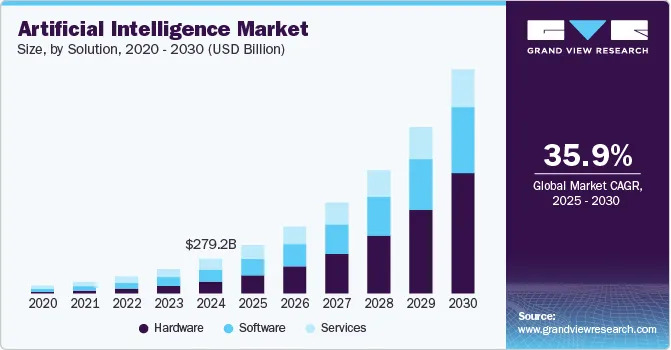
GRAND VIEW RESEARCH
What is AI Product Management?
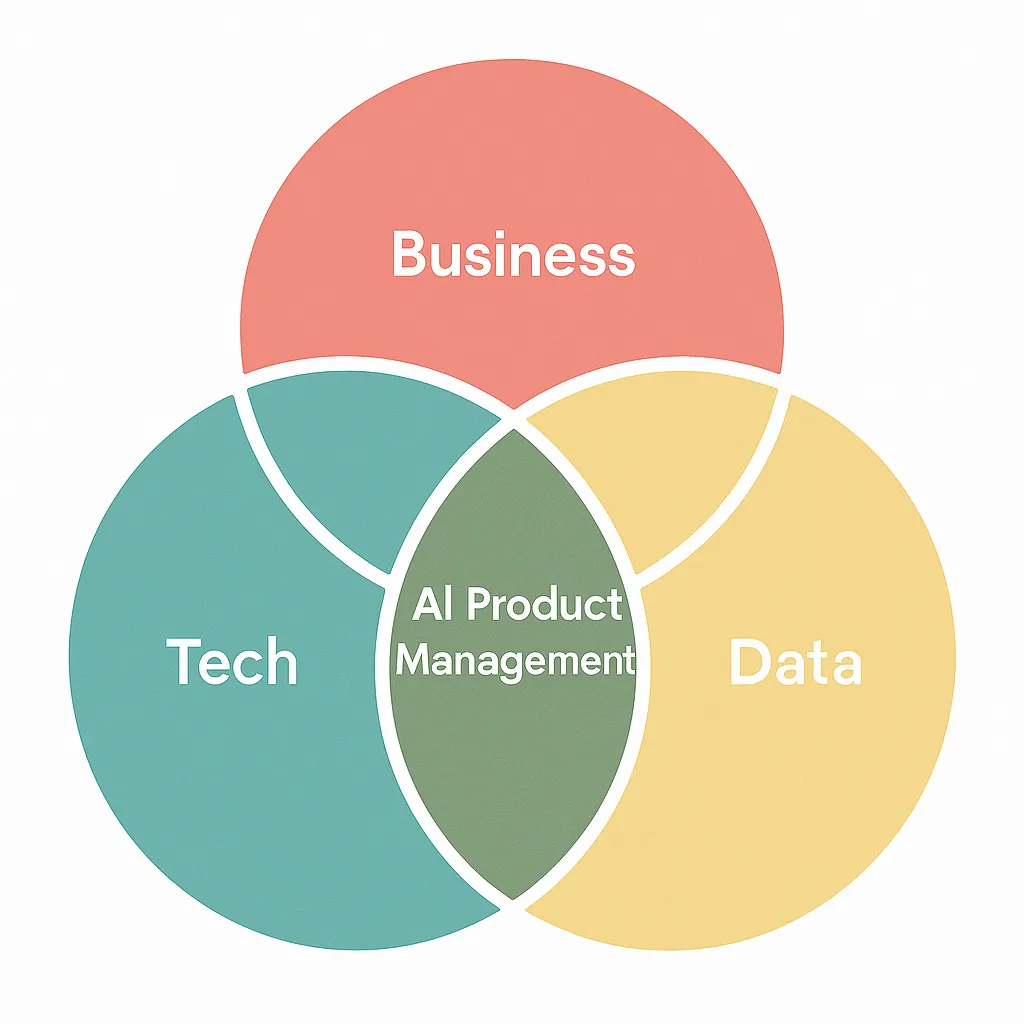
AI product management represents a specialized branch of conventional product management, concentrating on steering AI-driven products from the concept phase to their market introduction. This role is characterized by the profound incorporation of artificial intelligence and ongoing cooperation with data science teams.
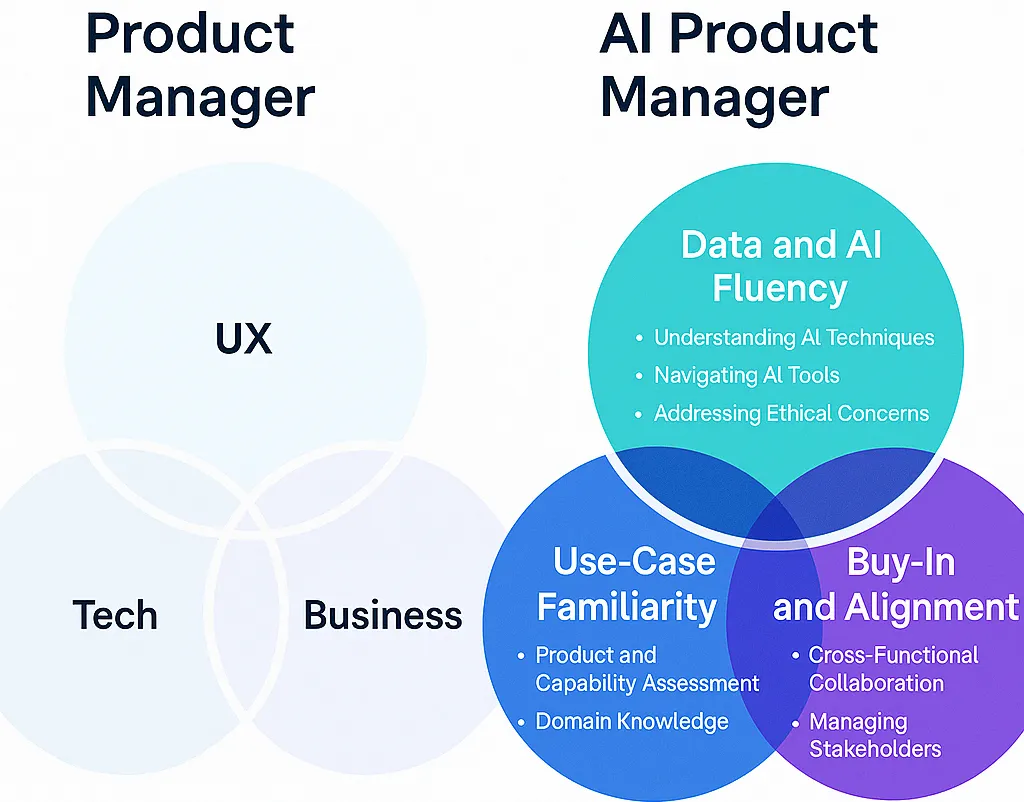
In contrast to traditional product managers, AI product managers emphasize machine learning (ML) and deep learning (DL) to guarantee that products are both user-focused and aligned with business goals. Their methodology is very technical, relies on data, and concentrates on performance.
Central to the development of AI products is machine learning, enabling systems to acquire knowledge and enhance their performance through data without the need for direct programming. This functionality is crucial for developing smart, flexible products in a rapidly changing AI environment.
Numerous major corporations in various sectors are incorporating AI into their offerings to provide enhanced and more tailored experiences. For instance, Amazon employs AI to examine customer buying habits and suggest products, or even automatically enroll them in subscriptions for essentials like pet food or household supplies before they deplete. Likewise, Netflix utilizes machine learning to customize content suggestions according to viewing history, increasing both engagement and retention.
In the automotive industry, Tesla leverages AI for its autonomous driving capabilities, enabling cars to adapt based on user actions and environmental factors. At the same time, Spotify utilizes AI to generate personalized playlists such as "Discover Weekly," anticipating user preferences based on their listening history.
These instances illustrate how AI product managers operate at the convergence of user experience, data analytics, and business strategy to develop smart, responsive systems.
What does an AI Product Manager do?
AI Product Managers (AI PMs) serve as essential bridges among various cross-functional teams, connecting data scientists, marketers, and other relevant parties. Their responsibilities include converting intricate AI ideas into straightforward, actionable insights tailored for different departments.
One of the primary duties of AI Product Managers is to establish achievable expectations. Their extensive knowledge of AI allows them to set precise metrics for monitoring product development and effectiveness. They depend significantly on data analysis to assess vast amounts of data and make sure that products meet both user requirements and business objectives.
The emergence of AI brings with it a great deal of responsibility. Although AI has the potential to revolutionize various sectors, it also introduces issues related to bias, fairness, and privacy. Product Managers for AI hold an essential position in maintaining ethical practices, making sure that AI-led experiences are responsible, inclusive, and centered around the user.
Why Product Managers Need to Understand AI and ML?
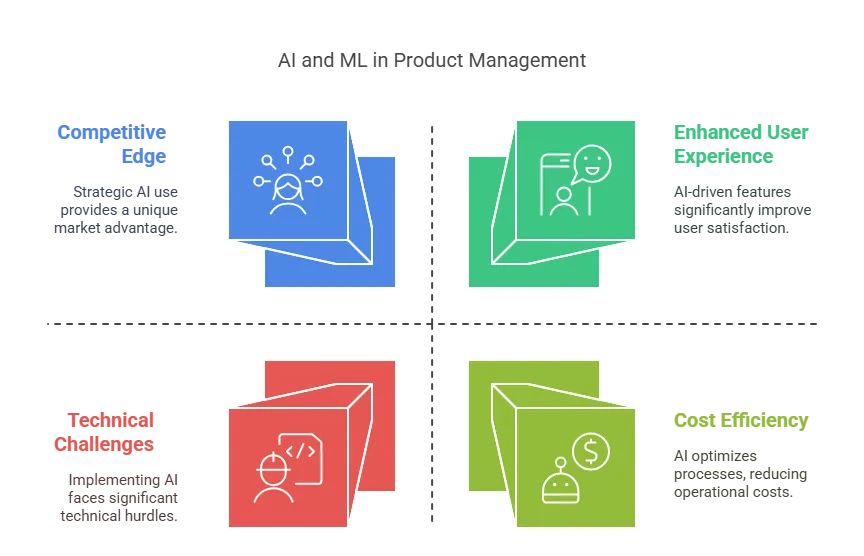
Product managers must grasp the benefits and drawbacks of AI and machine learning to drive innovation and achieve a competitive advantage. By fully understanding these technologies, PMs can create adaptable, high-performing solutions that meet evolving market demands and provide exceptional user experiences.
Essential AI PM skills
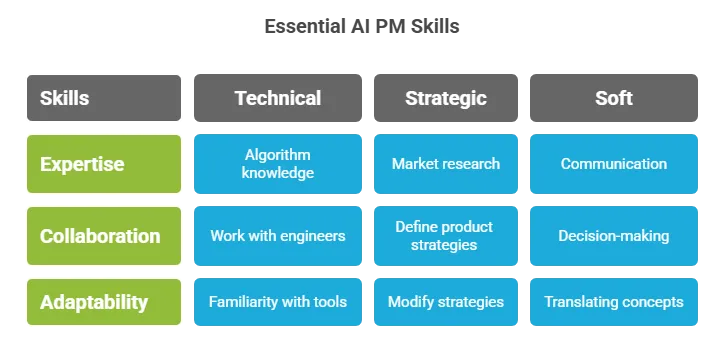
To effectively oversee successful AI products, an AI PM must possess a diverse set of skills. Technical expertise, strategic thinking, and interpersonal abilities are often central to the role of an AI PM.
Technical Skills:
A solid technical foundation is crucial for AI Product Managers. This encompasses an understanding of algorithms, data analysis, data engineering, and practical experience with leading AI tools. Familiarity with Python and fundamental software development is essential for overseeing intricate AI product lifecycles.
Grasping AI models allows for improved teamwork with engineers and data scientists, influencing feature development and the selection of appropriate modeling strategies. Knowledge of project management tools guarantees effective implementation of AI-based solutions.
Strategic Skills:
In addition to technical knowledge, strategic abilities are crucial for AI Product Managers. These abilities encompass performing market analysis, establishing product strategies, and creating adaptable product roadmaps.
Achieving success in product strategy necessitates a strong grasp of user insights, market trends, and competitive environments—coupled with the capability to adjust the roadmap as circumstances change.
Soft Skills:
Although technical and strategic abilities are crucial, interpersonal skills such as communication and decision-making serve as the cornerstone of successful AI product management.
Serving as a liaison between finance, data engineering, marketing, and sales, an AI PM must effectively convey the AI vision. This involves clarifying ideas, ensuring teams are on the same page, convincing stakeholders, and robustly justifying product choices.
9 Steps to Become an AI Product Manager in 2025
Here’s an extensive guide to assist you in becoming an AI Product Manager, complete with actionable steps to steer your path.
Step 1: Master AI & Machine Learning Fundamentals
Why it matters: To successfully lead AI products, it's essential to understand the core technologies driving the industry. Acquiring enough technical knowledge to collaborate with engineering teams and make informed choices is more crucial than having a background as a data scientist.
Action items:
- Explore the distinctions between AI, machine learning, and deep learning.
- Understand the basic principles of neural networks, including CNNs and RNNs.
- Analyze the differences between predictive models and discriminative models.
- Investigate the ethical and privacy considerations associated with AI.
Step 2: Understand Large Language Models (LLMs)
Why it matters: The emergence of LLMs has revolutionized AI applications across many fields. It is crucial for AI Product Managers to grasp the capabilities and constraints of these powerful models.
Action items:
- Analyze the components and structures of large language models (LLMs).
- Contrast the various types of LLMs and their unique features.
- Investigate the design of GPT and its abilities in language processing.
- Acknowledge the shortcomings of existing LLM technology.
Step 3: Learn Fine-Tuning Approaches
Why it matters: It's essential to comprehend how models can be customized for specific applications and industries to create specialized AI solutions.
Action items:
- Understand the criteria for selecting models across different applications.
- Learn how to format data for fine-tuning purposes.
- Analyze evaluation metrics like ROUGE.
- Engage in modifying models to suit specific business needs.
Step 4: Master Advanced Prompting Techniques
Why it matters: The difference between mediocre and exceptional AI applications comes down to the design of prompts. This skill allows you to maximize the potential of current models.
Action items:
- Apply the TCEPFT framework for structured prompting.
- Engage in prompting exercises with zero, one, and a few examples.
- Implement both tree-of-thought and chain-of-thought reasoning techniques.
- Identify and mitigate the risks associated with antagonistic prompting.
Step 5: Explore Generative Models & RAG
Why it matters: Retrieval Augmented Generation (RAG) and Generative Adversarial Networks (GANs) are transforming the way we access information and produce content, creating new possibilities for products.
Action items:
- Analyze the fundamentals and applications of GANs.
- Understand the framework and implementation of RAG.
- Identify scenarios for generating lifelike content.
- Investigate how RAG reduces hallucinations and enhances factual precision.
Step 6: Dive into Agentic AI
Why it matters: Recent developments in AI product creation are exemplified by AI agents that can perform tasks independently, creating entirely new product categories.
Action items:
- Understand the fundamentals and structure of agentic AI.
- Discover how to build AI agents from scratch.
- Explore methods for enhancing agent efficiency.
- Identify which business challenges are most appropriate for solutions driven by agents.
Step 7: Prioritize Ethical & Responsible AI
Why it matters: It is essential to deploy AI in a responsible manner to develop products that appeal to users and avoid adverse impacts.
Action items:
- Develop frameworks to tackle fairness and bias.
- Implement best practices for privacy and security.
- Create governance processes for the responsible development of AI.
- Enhance your skill in articulating ethical dilemmas to stakeholders.
Step 8: Apply AI Across the Product Lifecycle
Why it matters: Artificial Intelligence has the capacity to transform not just your approach to product development, but also the overall process of product management.
Action items:
- Enhance PRD creation by leveraging AI technologies.
- Implement roadmapping with the help of AI.
- Harness AI for competitor analysis.
- Increase efficiency by automating repetitive product management tasks.
Step 9: Build Your AI Product Yourself
Why it matters: Launching an actual AI-driven product is the most effective method to demonstrate your skills as an AI Product Manager, and it gains even more significance when included in a thoroughly documented portfolio that emphasizes your contributions, choices, and results.
Action items:
- Identify a current issue affecting the world and specify the target audience.
- Assess which AI capabilities are essential for tackling the problem.
- Create a feasible strategy for distributing resources and outline a timeline.
- Define success parameters and metrics for assessing the effectiveness of the product.
Ready to Master AI Product Management?
If you're a product manager feeling overwhelmed by starting your AI PM journey on your own, check out our advanced AI for Product Managers Program.
This comprehensive course is designed specifically for PMs who want to seamlessly integrate AI into their product strategy and development process, taught by industry professionals currently working at Google and Microsoft.
What You'll Master:
- Core AI and ML concepts tailored for product managers
- Advanced prompting techniques and LLM customization
- Building AI prototypes with no-code/low-code tools
- Strategic AI integration in product roadmaps
Join Waitlist Now:- AI For Product Manager [Only 4 Seats Left at Early Bird Price!]
Stay Updated: Follow The Product Space for the latest insights and resources on AI in product management.