
Introduction
A language model without tools is like a brilliant consultant locked in a room with no phone, no computer, no access to your files, and no ability to send emails. They can think. They can reason. They can tell you exactly what should happen. But they can't actually do anything.
This sounds obvious in hindsight. But for the first two years of the AI boom, we mostly ignored it. We are obsessed over model intelligence benchmark scores, reasoning quality, context windows and largely glossed over the infrastructure question: how does an AI system actually connect to the world it's supposed to operate in?
The answer, for most teams, was chaos. Custom API wrappers. One-off integrations. Brittle pipelines that broke every time a vendor changed their schema. A different implementation for every tool, every app, every data source.
That's the problem MCP was built to solve.
Model Context Protocol is the connectivity layer the agentic AI era has been waiting for. Here's everything you need to understand it.
The Problem: AI Models Are Isolated
A base language model, out of the box, exists in a kind of informational vacuum.
It knows what it was trained on. It can reason over what you give it in a conversation. But it cannot, on its own:
- Read your latest Slack messages
- Query your CRM for a customer's history
- Check whether a file was updated in the last 24 hours
- Run a SQL query on your database
- Push a commit to GitHub
- Book a calendar event
These aren't exotic capabilities. They're the basic actions any competent human employee performs dozens of times a day.
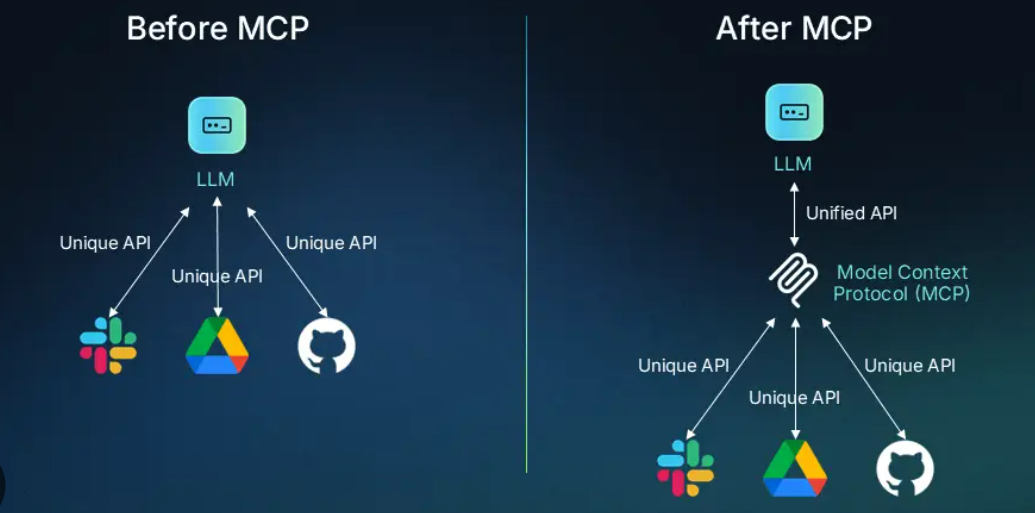
The early approach to solving this was direct API integration: write custom code that calls a specific API, formats the output, feeds it to the model, parses the response, and acts on it. This works. It's also expensive to build, brittle to maintain, and impossible to scale across dozens of tools.
Every new integration was effectively starting from scratch. There was no shared vocabulary, no standard handshake, no common protocol for how an AI system should discover what a tool can do, invoke it, and handle what comes back.
The result: AI products that technically "integrated" with your tools but required months of engineering effort per connection, and fell apart whenever the underlying API changed. The intelligence was there. The plumbing wasn't.
What Is MCP?
MCP stands for Model Context Protocol. It's an open standard created by Anthropic and now adopted well beyond Anthropic that defines a universal way for AI systems to discover, connect to, and interact with external tools, data sources, and applications.
The clearest definition:
MCP is a standardized communication layer that lets AI agents interact with the outside world.
If you've ever connected a USB-C device and it just worked no drivers to install, no compatibility research, no custom cables you understand the value MCP is trying to deliver. Before USB-C, every device had its own connector. Before MCP, every AI-to-tool integration had its own implementation. The fragmentation tax was paid by developers, over and over, for every new connection.
MCP is the USB-C for AI agents. One interface. Any tool. Any model that speaks the protocol.
You can also think of it this way:
- HTTP standardized how computers communicate over the internet. MCP standardizes how AI agents communicate with tools.
- APIs standardized how software systems expose capabilities. MCP standardizes how AI systems use those capabilities.
- Operating system drivers standardized how hardware connects to software. MCP standardizes how intelligence connects to infrastructure.
The ambition is that simple and that significant.
How MCP Actually Works
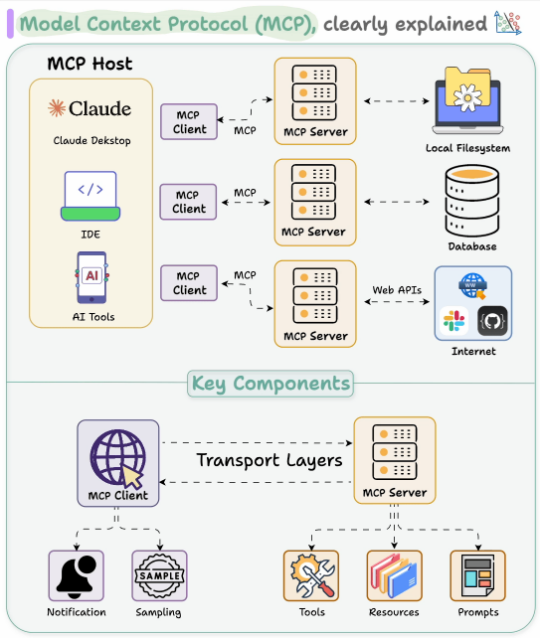
MCP operates on a client-server model. Here's the basic architecture:
MCP Servers expose capabilities they're the tools, data sources, or applications that want to be accessible to AI. A file system MCP server exposes file operations. A GitHub MCP server exposes repository actions. A Slack MCP server exposes messaging capabilities. Each server describes what it can do using structured schemas.
MCP Clients are the AI systems agents, assistants, workflows that want to use those capabilities. The client connects to one or more servers, discovers what tools are available, and invokes them as needed during a task.
The communication follows a standard structure:
- Discovery. The AI client asks the server: what can you do? The server responds with a structured list of available tools, including their names, descriptions, and input/output schemas.
- Invocation. When the AI determines it needs a tool say, to read a file or query a database it sends a structured tool call: the tool name, the parameters, formatted according to the schema.
- Response. The server executes the action and returns a structured result. The AI incorporates that result into its context and continues reasoning.
This is what a basic MCP workflow looks like in practice:
User asks an AI assistant to summarize last week's sales data.
Without MCP: the developer had to pre-build a custom integration to pull CRM data, format it for the model, handle authentication, manage errors, and wire it all together manually.
With MCP: the AI client discovers the CRM MCP server, sees that it has a "query_records" tool, invokes it with the right parameters, receives the structured results, and reasons over them all dynamically, all within the protocol.
The difference isn't just developer convenience. It's the difference between an AI that happens to have a few pre-wired tools and an AI that can dynamically discover and use any tool that speaks the protocol.
Why MCP Matters
Standardization unlocks compounding value.
When there was no standard for web communication, every network was its own island. HTTP created a common language, and the internet followed. When there was no standard for smartphone charging, every device came with its own brick. USB-C changed the economics of the entire accessories market.
Protocols create ecosystems. Ecosystems create compounding network effects. And compounding network effects are how infrastructure becomes foundational.
MCP matters because:
It dramatically reduces integration complexity. Build an MCP server once for your tool, and any MCP-compatible AI agent can use it. Build an MCP client once, and your AI can connect to any MCP-compatible tool. The combinatorial explosion of possible connections becomes manageable.
It enables truly composable AI systems. Because tools are discovered dynamically rather than hardcoded, agents can be assembled from modular components. An agent for legal research uses different MCP servers than one for DevOps automation and the same underlying model can power both.
It creates a permission and security layer. MCP includes built-in structures for defining what a tool can and cannot do, managing authentication, and scoping access. This matters enormously for enterprise AI, where governance isn't optional.
It aligns incentives for a tool ecosystem. Developers building MCP servers know their work will be compatible with any AI system that adopts the protocol. That's a much better surface area to build on than "integrate specifically with GPT-4" or "integrate specifically with Claude."
The future AI ecosystem won't be built on isolated models. It will be built on connected systems.
Real-World MCP Use Cases
Claude Desktop was one of the first mainstream showcases for MCP. Users can connect Claude to their local file systems, databases, and applications letting it read, write, and act on real data rather than just discuss it.
AI coding assistants use MCP to connect to file systems, terminal outputs, test runners, and version control. Cursor's deep code context isn't magic it's structured tool access that surfaces the right files, diffs, and error logs into the model's working context.
Enterprise copilots at serious companies are built on MCP-like architectures: connecting AI to CRM systems, ticketing platforms, internal wikis, and communication tools. The AI doesn't just answer questions about the business it can query records, update statuses, and trigger workflows.
Research agents connect to web search, academic databases, file storage, and note-taking systems via MCP servers, building structured context from multiple sources before synthesizing an answer.
Customer support AI uses MCP to access order history, account records, policy documents, and ticketing systems in real time giving it the context to actually resolve issues, not just acknowledge them.
In each case, the pattern is the same: MCP is the difference between an AI that talks about your business and an AI that operates within it.
MCP vs. Traditional APIs
APIs aren't going away. MCP isn't replacing them. Understanding the relationship is important.
| Dimension | Traditional API | MCP |
| Integration model | Point-to-point, custom per tool | Standardized, universal protocol |
| Discovery | Manual: developer reads docs | Dynamic: agent discovers at runtime |
| Flexibility | Fixed per integration | Composable across any MCP tool |
| AI compatibility | Requires custom wrappers | Native to AI agent workflows |
| Scalability | Each new tool = new integration | Each new MCP server = plug-and-play |
| Tool orchestration | Manual coordination | Protocol-native |
| Developer experience | Rebuild for every connection | Build once, connect anywhere |
The clearest way to think about the distinction: APIs are the roads. MCP is the GPS.
APIs define how you can travel between two specific points. MCP is the navigation system that lets an AI agent figure out, in real time, which roads exist, which ones to take, and how to get where it's going without a human mapping the route in advance.
MCP and the Rise of AI Agents
The chatbot era asked: what can AI say?
The agentic era asks: what can AI do?
That's a fundamentally different question and it requires fundamentally different infrastructure. Agents don't just respond to prompts. They plan multi-step tasks, call tools, process results, adjust their approach, and complete goals that span minutes or hours rather than seconds.
MCP is to agentic AI what TCP/IP was to networked computing. It's the protocol that makes the whole system work together.
Without something like MCP, multi-agent systems become a coordination nightmare every agent speaks a different dialect, every tool requires a custom adapter, every workflow is a bespoke engineering project. With MCP, agents can discover each other's capabilities, delegate tasks, share context, and compose into systems that are genuinely greater than the sum of their parts.
MCP turns AI from a conversational interface into an operational system.
The New AI Stack
The old mental model: Model + Prompt → Output.
The emerging mental model:
User Intent
↓
Orchestration Layer (agent logic, planning)
↓
MCP Client (tool discovery and invocation)
↓
MCP Servers (tools, data, APIs, apps)
↓
Context Assembly (retrieved data + tool results + memory)
↓
Model (reasoning over assembled context)
↓
Action or Output
The model is one component. The MCP layer is the connective tissue. The context system is what makes the model useful. The orchestration layer is what makes it autonomous.
Infrastructure is the next AI battleground. The teams winning in 2026 and beyond won't just have access to capable models every serious team does. They'll have better context systems, richer tool ecosystems, and more sophisticated orchestration layers. MCP is one of the foundational standards making that possible.
Risks, Limitations, and Open Questions
MCP is powerful, but it's not magic and it's still maturing.
Security and permissions are non-trivial. An AI agent with access to your file system, email, and CRM is enormously capable. It's also a significant attack surface. MCP includes permission structures, but implementing them rigorously in production requires real security engineering.
Tool hallucinations remain a real problem. A model might invoke a tool with incorrect parameters, misinterpret the output, or call the wrong tool entirely. The protocol can't fix reasoning errors it can only structure the interface.
Standard fragmentation is a genuine risk. MCP is the leading candidate for an AI connectivity standard, but the ecosystem is young. If major players fragment into incompatible implementations, the promise of plug-and-play composability breaks down.
Reliability at scale in long-running agentic workflows is still an open research and engineering problem. Chains of tool calls can fail in complex ways, and MCP doesn't automatically solve the error-handling and retry logic that production systems require.
None of these are arguments against MCP. They're honest assessments of what the protocol is and isn't. MCP gives agents the right plumbing. Building reliable, secure, production-grade agents on top of it still takes real work.
What Builders Should Learn Now
If you're building AI products, here's where to focus:
Learn the MCP architecture. Understanding clients, servers, tool schemas, and invocation patterns is foundational knowledge for anyone building agentic AI. The Anthropic MCP documentation is thorough and accessible.
Build or identify MCP servers for your core data sources. Whatever proprietary data or systems your AI needs to access that's where your first MCP infrastructure investment pays off.
Think in workflows, not conversations. Agentic AI design is closer to process engineering than chatbot design. Map the tasks your AI should complete, identify the tools it needs, and design the orchestration logic accordingly.
Treat interoperability as a moat. Teams that build well-structured, MCP-compatible tool ecosystems will compound advantages as more agents and models adopt the protocol. The work you do now to structure your AI's connections will compound.
Watch the ecosystem. The MCP server marketplace is growing rapidly. Tools, apps, and data sources are publishing MCP servers at an accelerating rate. Following this ecosystem is like following the npm registry in 2012 the velocity of available tooling is about to increase dramatically.
Conclusion
The internet connected computers. HTTP made them speak the same language.
APIs connected software systems. REST standardized how they exposed their capabilities.
Now AI is connecting intelligence to the world. MCP is potentially how it learns to speak a common language with everything.
That's a big claim. But the logic is sound. Every wave of computing has required a connectivity protocol: something that lets the new paradigm plug into infrastructure, tools, and systems that already exist. Every time that protocol emerged and standardized, an ecosystem followed. Every time an ecosystem formed around a protocol, it became infrastructure too foundational to ignore.
We are early. MCP will evolve. Competing standards may emerge. The specific implementation details will change.
But the underlying need a universal way for intelligent systems to connect to the world they're supposed to operate in is not going away. It's becoming more urgent every month.
The models are ready. The agents are coming. The protocol is the missing piece.
Build accordingly.
Comparison Table
| Dimension | Traditional API Integration | MCP Integration |
| Integration model | Custom, point-to-point per tool | Universal, protocol-standardized |
| Tool discovery | Manual: hardcoded by developers | Dynamic: discovered at runtime |
| Flexibility | Rigid; changes require code updates | Composable; tools plug in without rewiring |
| AI compatibility | Requires custom wrappers per model | Natively compatible with any MCP client |
| Scalability | Each new tool = full integration project | Each new MCP server = immediate availability |
| Tool orchestration | Developer-managed, bespoke logic | Protocol-native, agent-managed |
| Developer experience | High overhead; rebuild per connection | Build once; connect anywhere |
| Security model | Custom per integration | Structured permissions in protocol |
FAQ Section
What is MCP? MCP (Model Context Protocol) is an open standard that provides a universal communication layer for AI agents to connect to tools, applications, databases, and external data sources. It defines how AI systems discover available tools, invoke them, and process their outputs in a standardized, interoperable way.
What does MCP stand for? MCP stands for Model Context Protocol.
Who created MCP? MCP was created by Anthropic, the AI safety company behind Claude. It has since been adopted as an open standard, with growing support from developers and companies across the AI ecosystem.
How does MCP work? MCP operates on a client-server model. MCP servers expose tools and data sources with structured schemas describing their capabilities. MCP clients AI agents or assistants connect to these servers, discover what tools are available, invoke them as needed, and incorporate the results into their reasoning context.
Why is MCP important for AI agents? AI agents need to interact with the real world to be useful reading files, querying databases, sending messages, calling APIs. Without a standard protocol, every connection requires custom integration work. MCP provides a universal interface, letting agents dynamically discover and use any tool that implements the protocol.
Is MCP replacing APIs? No. MCP doesn't replace APIs it standardizes how AI agents use them. Traditional APIs define how two software systems communicate. MCP defines how an AI agent discovers, invokes, and coordinates API-based tools at runtime. The two are complementary.
What companies are using MCP? Anthropic (via Claude Desktop and Claude API), along with a growing ecosystem of developer tools, enterprise software providers, and AI infrastructure companies. The MCP server ecosystem is expanding rapidly, with integrations for GitHub, Slack, databases, file systems, CRMs, and many other tools.
What is the difference between MCP and function calling? Function calling (as implemented in OpenAI's API, for example) allows a model to invoke pre-defined functions during a conversation. MCP extends this concept into a full protocol adding standardized discovery, structured schemas, server-side tool management, and interoperability across different models and platforms.