
The product management job market has split in two, and the divide is getting wider by the month.
On one side, AI-fluent PMs are fielding multiple offers, commanding salaries that have jumped 20 to 40 percent above pre-2023 benchmarks, and stepping into roles that didn't exist two years ago. On the other side, generalist PMs with five to eight years of experience and solid track records are facing layoffs, six-month job searches, and rejection emails from companies they would have easily gotten into in 2021.
This is what economists call a K-shaped recovery. Two trajectories, moving in opposite directions at the same time, driven by the same underlying force.
Understanding why this is happening, and what it means for where you sit in the market right now, is the most important career conversation any PM should be having in 2025.
What K-Shaped Actually Means in This Context
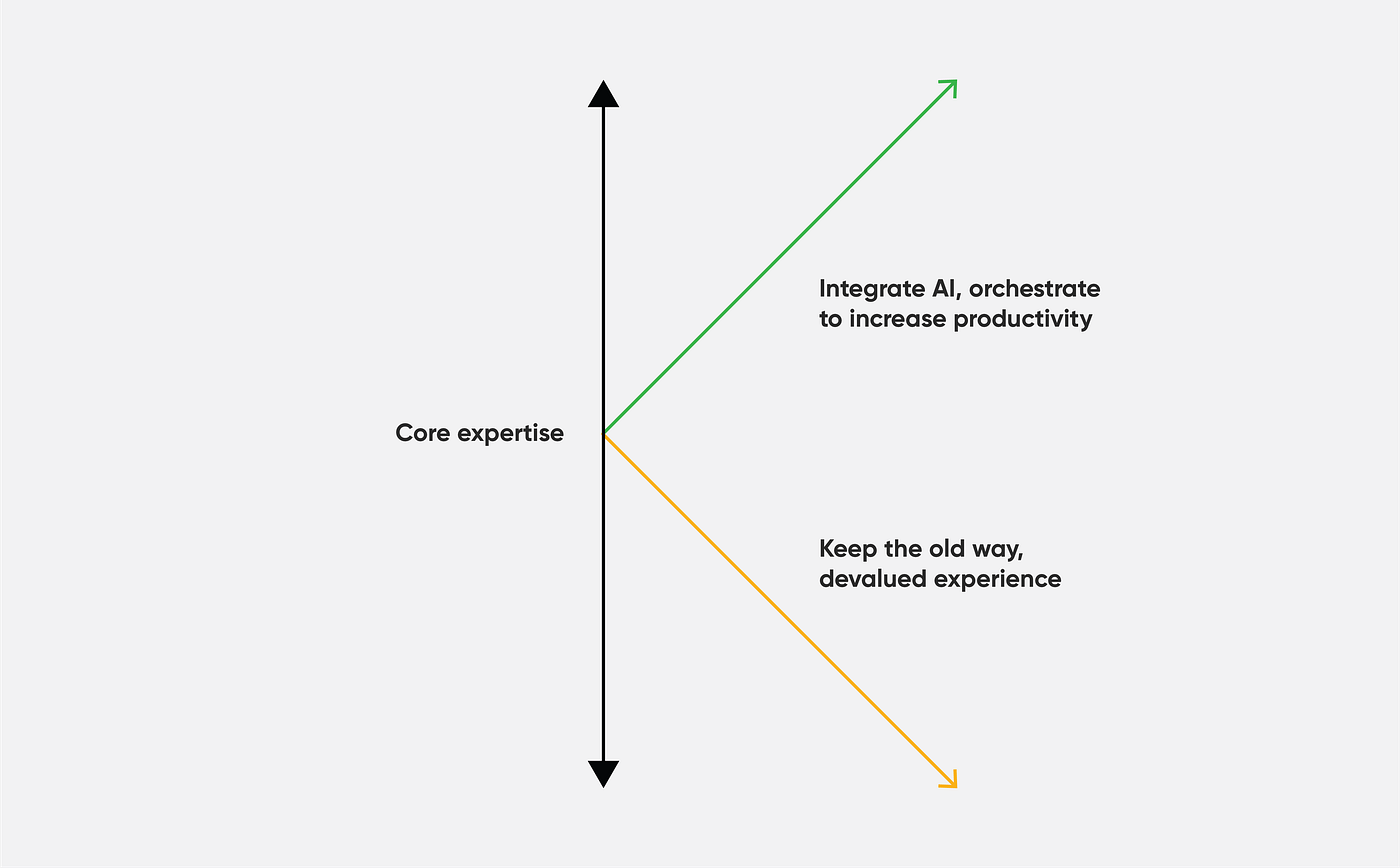
A K-shaped market is one where a single disruption splits an industry into two groups moving in opposite directions. The top arm of the K rises. The bottom arm falls. The people in the middle, the ones who assumed stability would continue, get sorted into one arm or the other based on factors they often didn't see coming.
In the PM job market, the disruption is AI. Not AI as a buzzword, and not AI as a set of features to add to a product roadmap. AI as a fundamental shift in what companies need from product managers, how many of them they need, and what skills justify the salary.
The top arm of the K represents PMs who have built genuine fluency with AI tools, AI products, and AI-driven workflows. They are not just aware of what AI can do. They can specify it, scope it, measure it, and communicate it to both technical and non-technical stakeholders. They understand the difference between a model that works in a demo and a model that works in production. They know how to write evals, what fine-tuning is and when it matters, what retrieval-augmented generation means for product decisions, and how to manage the user trust problems that come with AI outputs.
The bottom arm represents PMs who accumulated experience in a world where the job was about managing roadmaps, writing user stories, running sprint ceremonies, and being the bridge between business and engineering. That work was real and valuable. But it has become increasingly commoditised, and in many organisations, it has become automatable. The headcount that used to support it is contracting.
Why Companies Are Cutting Generalist PMs
The cuts are not random. They follow a clear logic that most organisations are not saying out loud but are absolutely acting on.
AI is compressing the PM-to-engineer ratio. Historically, product teams operated on a rough ratio of one PM for every five to eight engineers. That ratio made sense when the overhead of coordination, documentation, ticket writing, and roadmap management required dedicated headcount. AI tools are reducing that overhead significantly. One AI-fluent PM can now do the coordination and documentation work that previously required two. Companies are adjusting headcount to match.
Generalist output is being partially automated. The work that defined mid-level PM roles for the last decade, writing PRDs, summarising research, drafting tickets, creating alignment documents, is exactly the work that AI handles well. When a company can produce that output with one senior AI-fluent PM and a set of AI tools, the business case for three generalist PMs at the same cost collapses.
Organisations are consolidating around depth. In the previous hiring cycle, many companies scaled PM teams aggressively on the assumption that coordination capacity was the bottleneck. It wasn't. The bottleneck was judgment and domain expertise. As organisations run leaner, they are prioritising PMs who bring irreplaceable depth, either in AI product knowledge specifically, or in a domain where AI is creating major disruption and strategic decisions require informed human judgment.
The cost equation has changed. A generalist PM at a mid-level salary made economic sense when the work they did required their full attention and couldn't be done any other way. When the same work is completable in a fraction of the time with AI assistance, the cost-to-output ratio shifts. Companies either hire fewer PMs or pay significantly more for PMs who can produce substantially more.
What AI Product Managers Actually Do Differently
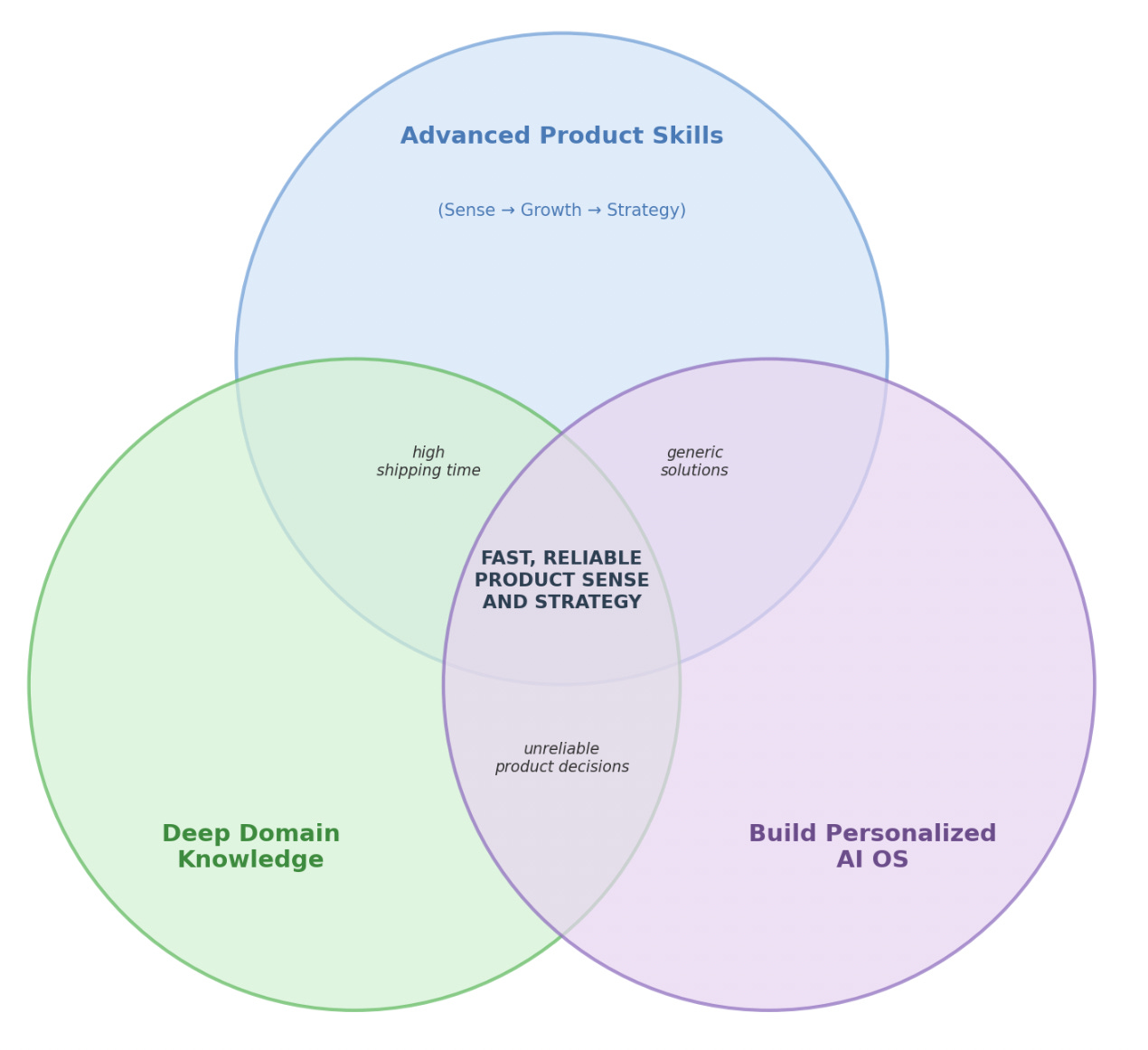
The phrase "AI PM" gets used loosely, and that looseness creates confusion. An AI PM is not just a PM who uses ChatGPT to edit emails or someone who added "AI/ML experience" to their LinkedIn.
They understand the product surface of AI systems. AI products have failure modes that traditional software products don't. A model can be accurate on average but wrong in specific high-stakes cases. It can hallucinate, produce outputs that are plausible but incorrect, or degrade in performance when inputs shift from the training distribution. An AI PM understands these failure modes and designs around them, specifying guardrails, fallback behaviours, confidence thresholds, and human review workflows as part of the product definition rather than as afterthoughts.
They can write and interpret evaluations. Measuring whether an AI feature is working is fundamentally different from measuring whether a traditional software feature is working. An AI PM knows how to define evaluation criteria, work with engineering to design test sets, interpret precision and recall trade-offs in the context of user experience, and use that data to make product decisions. This is a skill most generalist PMs don't have and can't easily fake in an interview.
They manage trust as a product variable. Users interact with AI products differently than they interact with deterministic software. Trust calibration matters enormously. An AI PM thinks about how to design interfaces that communicate uncertainty appropriately, how to handle cases where the AI is wrong, and how to build user confidence incrementally. This requires a depth of thinking about the human-AI interaction that goes well beyond standard UX considerations.
They speak the technical language without needing to be engineers. They know what a transformer architecture is at the conceptual level, can discuss fine-tuning versus prompt engineering versus retrieval-augmented generation in the context of a product decision, understand the cost and latency implications of model size, and can have a substantive conversation with an ML engineer about what is and isn't technically feasible. They are not writing code. But they are not asking engineering to explain foundational concepts from scratch in every meeting either.
They use AI tools to multiply their own output. An AI PM working with Claude, Cursor, or a set of custom workflows produces the documentation, research synthesis, and stakeholder communication that would have taken a team of PMs in 2021. They are not faster at the same tasks. They are operating at a fundamentally different level of scale.
The Skills That Separate the Two Arms of the K
The divide between the top and bottom arms of the K is not about years of experience, company pedigree, or raw intelligence. It is about a specific cluster of skills that were not required for PM success three years ago but are becoming the baseline for PM viability now.
Technical AI literacy. Not deep enough to build models, but deep enough to evaluate them, scope them, and make product decisions about them. This means understanding the fundamentals of how large language models work, what they are consistently good at and consistently bad at, how to think about model selection for a given product use case, and what the infrastructure around a production AI system looks like in practice.
Data fluency at the product level. AI products are data products. A PM who cannot read a confusion matrix, interpret an A/B test on an AI feature, or reason about data quality and its impact on model performance is missing a foundational skill for this market. This is not statistics at a research level. It is applied data reasoning in the context of product decisions.
Prompt engineering and workflow design. This sounds narrow but it isn't. A PM who knows how to structure prompts, design multi-step AI workflows, and evaluate AI outputs at a systems level is a PM who can move faster, produce better specifications, and demonstrate AI fluency to hiring managers in a concrete and testable way.
AI product strategy. Understanding where AI creates defensible product value versus where it creates temporary advantage that competitors can easily replicate. Understanding the build-versus-buy decision for AI capabilities. Understanding how to sequence AI feature development in a way that creates compounding advantages over time. These are strategic skills that AI-native PMs are developing in real time and that most generalist PMs have not had cause to develop yet.
Comfort with a higher level of ambiguity. Traditional PM work involves ambiguity about user needs and market direction. AI PM work involves all of that plus fundamental uncertainty about whether the model will work, whether the outputs will be trusted, and whether the product will behave consistently across edge cases. Navigating that additional layer of uncertainty is a genuine skill, and experienced hiring managers can tell quickly whether a candidate has developed it.
Where the Market Is Heading
The K-shape is not a temporary condition that will normalise when hiring picks up. The structural forces driving it are getting stronger.
AI capabilities are improving faster than most companies are building the product expertise to use them. That gap creates sustained demand for PMs who can bridge the technical and product sides of AI development, and that demand is going to stay elevated for the foreseeable future. As more companies move from experimenting with AI features to treating AI as core to their product strategy, the need for PMs who can operate at that level scales with the investment.
At the same time, the commoditisation of generalist PM work will continue. The tools are getting better, the workflows are becoming more established, and organisations are getting more efficient at doing with one AI-fluent PM what used to require three. This is not a reason for panic. It is a reason to be clear-eyed about where the market is going and make deliberate choices about where to position yourself within it.
The PMs who thrive over the next five years will be the ones who treat AI fluency as a core professional capability rather than a nice-to-have skill, build enough technical depth to have substantive conversations about AI product decisions, develop genuine expertise in at least one domain where AI is creating major disruption, and use AI tools aggressively in their own workflows so that their output quality and speed reflects the new standard of what a strong PM can produce.
What This Means If You're a Generalist PM Right Now
Being a generalist PM in this market is not a terminal situation. It is a starting point that requires honest assessment and deliberate action.
The first question worth answering is where on the K you currently sit and which direction you are moving. If you have been using AI tools in your daily work, developing informed opinions about AI product decisions, and building any kind of technical literacy around how AI systems work, you are probably closer to the top arm than you realise. The gap may be smaller than it looks.
If you have been largely treating AI as something engineering handles, or using AI tools superficially without developing real fluency, the gap is real and it is growing. The good news is that the skills required to close it are learnable. They are not gated by a computer science degree or years of ML research experience. They require deliberate investment, which any motivated PM can make.
The practical starting point is to get hands-on with AI tools in a way that goes beyond surface use. Build something with an AI API, even something small. Learn enough about how large language models work to have an informed opinion about their limitations. Take on a project at your current company that involves an AI feature and develop the product thinking around it. The goal is not to become an ML engineer. The goal is to develop the product fluency to work effectively at the intersection of AI capability and user need.
The PMs who close that gap fastest are the ones who approach it with the same rigour they would bring to any product problem: defining the skill gap clearly, identifying the fastest path to developing those skills, and measuring their progress against a real-world standard rather than a course completion certificate.
Conclusion
The K-shaped PM job market is a symptom of something larger: a wholesale restructuring of what product work looks like when AI becomes a core part of both the product being built and the workflow used to build it.
That restructuring creates real displacement, and it is worth acknowledging honestly. The careers that looked stable two years ago are less stable today through no fault of the individuals who built them. The skills that earned recognition and promotions are being devalued faster than the people who hold them have had a chance to adapt.
But the restructuring also creates genuine opportunity at the top of the K for PMs who move deliberately, develop real depth, and position themselves at the intersection of AI capability and product strategy. That intersection is where the most interesting product problems are being solved right now, and it is where the most significant career leverage exists for anyone willing to build toward it.
The market has split. The question worth sitting with is which arm you intend to be on, and what you are going to do about it.