
A competitor can see your feature ship on Monday, reverse-engineer it by Wednesday, and be live before the weekend. This is not an exaggeration. It is the operating reality that every product team in this piece has built their culture around.
What is changing is not the pace of the market. The market has always been this fast. What is changing is how much a single product team can produce inside that pace, and the answer, for the organisations that have figured it out, is significantly more than was possible two years ago.
The teams at Razorpay, CRED, Zepto, and Swiggy are not using AI the way most organisations talk about using AI, which is cautiously, selectively, and mostly in workflows that were already low-stakes. They have embedded it into the core of how products get discovered, specified, built, and shipped. The result is a structural output advantage that is now showing up in how fast they move, how lean their teams run, and how much ground they cover per sprint cycle.
This piece is about what that actually looks like.
The Problem AI Is Solving at This Level
Before getting into the specifics, it is worth naming the problem precisely, because the way most people talk about AI in product development misses it.
The bottleneck in a high-performing product team is almost never raw work capacity. Senior PMs and strong engineers are capable of sustained high output. The bottleneck is the cost of moving from information to decision. How long does it take to go from a set of user signals to a clear problem statement? How long from a clear problem statement to a specification that engineering can act on? How long from a shipped feature to a confident read on whether it worked?
In traditional product workflows, those transitions are slow because they depend on manual synthesis, sequential handoffs, and analysis cycles that have fixed minimums regardless of urgency. A research synthesis that should take two days takes two weeks because the analyst has three other priorities. A specification review that should catch edge cases misses them because it happens under time pressure. A post-launch analysis that should inform the next iteration arrives after the next sprint has already started.
AI, used well, compresses each of those transitions. And the compounding effect of compressing all of them simultaneously is what produces the 10x output differential that the best teams are experiencing.
This is the frame through which the four companies in this piece should be understood.
Razorpay: Closing the Gap Between Signal and Decision
Razorpay sits at an unusual position in the product ecosystem. Its decisions affect not just its own users but every merchant and developer building on top of its APIs. The signal volume coming from that ecosystem is significant. Merchant support tickets, developer forum discussions, API usage patterns, and payment failure data collectively represent a rich picture of where the product is working and where it is not.
The problem was always processing that signal fast enough to act on it. A friction point in the merchant onboarding flow might take two weeks of research to surface, another week to validate, and then enter a prioritisation queue where it competed with everything else on the roadmap. By the time it shipped, the developers who experienced it had formed a lasting opinion.
AI changed that cycle fundamentally. Pattern recognition across the full signal corpus now surfaces actionable product insights in hours, with supporting evidence already aggregated. The research phase that previously consumed the first third of any product cycle has compressed enough that more of the cycle is available for the specification and build work that requires human judgment.
The specification layer tells an equally important story. For a payments product, an incomplete spec is not a minor inconvenience. A missing edge case in a payment flow is a production issue that affects thousands of transactions. Razorpay's teams now use AI to stress-test specifications before they reach engineering, catching gaps in the drafting phase rather than in code review. The downstream effect is fewer cycles spent on rework and more available for forward progress.

CRED: Personalisation as the Product Itself
CRED's product is built on a premise that is simple to state and operationally brutal to execute: make premium users feel genuinely understood, at scale, consistently. Not understood in a generic rewards-program way. Understood in a way that makes the product feel curated for each individual.
At a few thousand users, that is achievable through craft. At millions of users, it requires infrastructure that operates faster than any human team can work, processing more signals than any human team can see.
AI is the infrastructure that makes the CRED product possible at its current scale. The personalisation systems process behavioural signals continuously across the user base, and the output feeds directly into product decisions about feature development, reward surfacing, and experience design. The feedback loop between what users do and what the product team decides to build next has shortened from weeks to days, and in some cases to hours.
The experimentation layer reflects the same philosophy. Running concurrent product experiments across a segmented user base, while correctly attributing outcomes and identifying interactions between experiments, is a coordination problem that manual processes cannot solve at their scale. AI tools enable the product team to run more experiments, extract cleaner signals from them, and act on those signals faster. The compounding effect over time is a larger body of validated product knowledge and a shorter path from hypothesis to shipped improvement.
What is worth noting about CRED specifically is that they are not using AI to do what they were already doing, faster. They are using AI to do something that would not otherwise be possible at all.

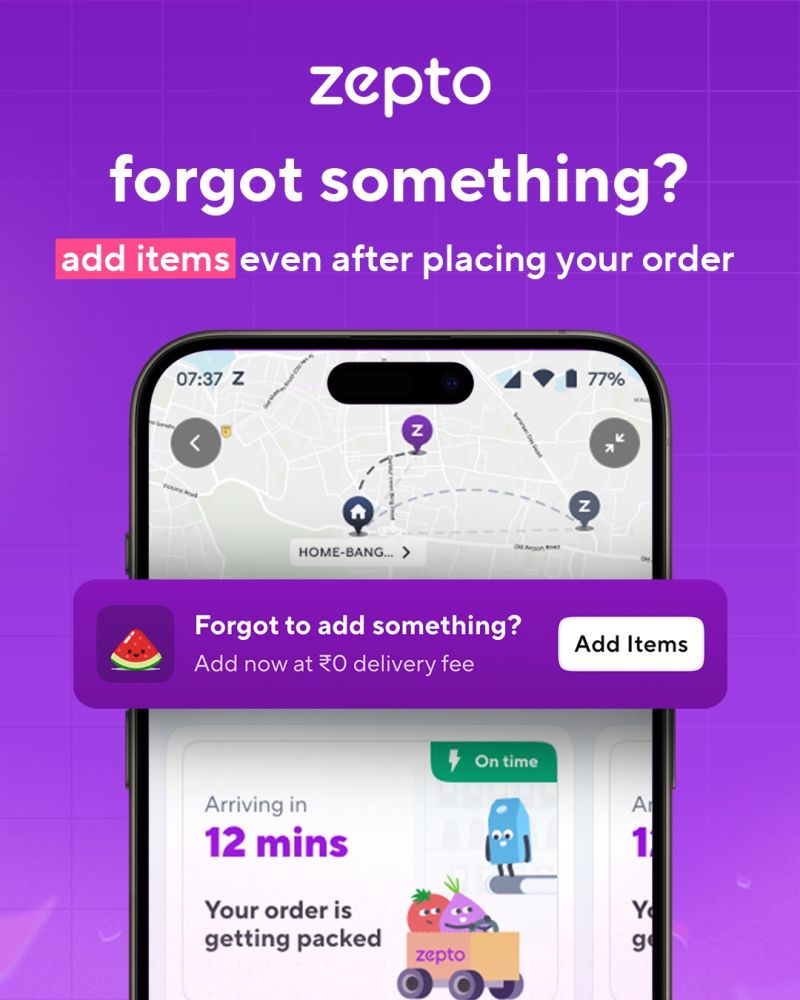
Zepto: When the Product and the Operation Are the Same Thing
Quick commerce is a product category where the experience and the execution are inseparable. A ten-minute delivery is simultaneously a product promise and a logistics outcome, and the systems that determine whether it happens are both at once.
This is what makes Zepto's relationship with AI structurally different. AI at Zepto is not primarily a tool for faster documentation or better ticket writing. It is the operating layer for a product that processes thousands of decisions per minute across dark stores, delivery partners, and user orders simultaneously.
Demand forecasting at a hyperlocal level is a product function at Zepto, not a supply chain function. The accuracy of the prediction of what a specific neighbourhood will order in the next two hours determines how the dark store is stocked, which directly determines whether the delivery promise holds. AI systems process real-time and historical data together to produce those predictions at a granularity that no analyst team could replicate manually, and the output feeds directly into product decisions about category expansion, dark store placement, and inventory depth.
The user-facing product benefits from the same infrastructure. Purchase patterns that predict long-term retention, intervention moments that improve lifetime value, and segmentation that identifies at-risk users before churn becomes visible in surface metrics are all outputs of AI systems that the product team uses as inputs into decisions that would previously have required months of manual analysis.
The feedback loop at Zepto between what happens in the field and what the product team acts on is shorter than at almost any other consumer internet company in India. That speed of iteration is visible in how quickly Zepto has expanded and refined its product in a category that was considered settled before they entered it.
Swiggy: Building AI Infrastructure Across a Multi-Product Platform
Swiggy's product challenge is distinct from the others in this piece because Swiggy is not a single product. It is a platform running food delivery, quick commerce, dining, and more simultaneously, each with its own competitive dynamics, user behaviour, and engineering requirements.
The approach Swiggy has taken to AI reflects a deliberate strategic choice: build shared AI infrastructure that all product teams inherit, rather than allowing each team to develop isolated capabilities that cannot share learning or compound across the platform.
The practical implication is significant. Models trained on food delivery behaviour inform quick commerce recommendations. Restaurant search behaviour informs dining product decisions. A signal that would be weak in isolation becomes a strong signal when viewed against a user's behaviour across the full platform. Competitors who have not invested in shared AI infrastructure cannot access that compounding, regardless of how sophisticated their individual product teams are.
The delivery logistics system illustrates how deeply this integration runs. Delivery partner assignment, route optimisation, and ETA prediction are AI-driven systems that Swiggy's product managers own as product systems, not as engineering concerns. They define success metrics, run experiments on the decision logic, and iterate on the behaviour of systems processing millions of events per day. This is a category of product management that requires genuine AI fluency, and it is increasingly the template for what senior PM roles at Swiggy look like.
Dynamic pricing and supply-demand management follow the same logic. The product teams responsible for those systems design the adjustment logic in ways that have to be economically viable and acceptable to users simultaneously, at a scale where manual calibration is not an option. Getting that balance right is a product problem that has no solution that does not involve AI, and the PMs who own those systems are developing a form of product expertise that is genuinely new in the industry.

What This Means for Every Other Product Team
The advantage these four organisations have built is not primarily about the tools they use. It is about the structural decisions they made early about how AI fits into their product process.
They treated AI as infrastructure rather than as a feature. They shortened the feedback loop between data and product decision deliberately and systematically. They expanded the scope of what product managers own to include the logic of AI systems, not just the specifications of traditional software. And they made AI fluency a team-level expectation rather than a specialist role.
Each of those decisions is available to any product organisation willing to make them. The tools are not proprietary. The frameworks are not secret. What separates the teams at the top of this market from the ones watching from a distance is the decision to move, and how early that decision was made.
The compounding that has already accumulated at Razorpay, CRED, Zepto, and Swiggy over the last eighteen months represents a gap that grows with every sprint cycle. The organisations that restructure their product process around AI now will be operating at a level of output and iteration speed that later movers cannot close quickly.
India's fastest product teams were already fast before AI. What AI has given them is the ability to scale that speed in a way that was not structurally possible before. That is a different kind of advantage, and it is one that the rest of the industry is only beginning to reckon with.