After helping dozens of PMs land roles at top-tier companies, I've noticed something: the candidates who couldn’t clear behavioral rounds aren't the ones lacking experience but they're the ones who can't tell their story.
Last month, I watched a brilliant PM with 5 years of experience stumble through "Tell me about a time you disagreed with engineering." Her answer was a rambling 4-minute story where she was somehow both the hero and the victim, with no clear outcome. She didn't get the job.
The behavioral round isn't about having perfect experiences. It's about demonstrating how you think, lead, and grow through the realities of product work.
Why Behavioral Rounds Make or Break PM Candidates
Here's what most PM interview guides won't tell you: your technical skills got you the interview, but your behavioral answers determine if you get the job.
I've sat in countless debrief sessions where hiring managers say things like:
- "Technically strong, but I'm not sure how they'd handle conflict"
- "Great product sense, but would they own failures?"
- "Smart person, but would our engineers respect them?"
Product management is fundamentally a people job. You're constantly navigating competing priorities, building consensus without authority, and making decisions with incomplete information. The behavioral round tests whether you can actually do this work not just talk about frameworks.
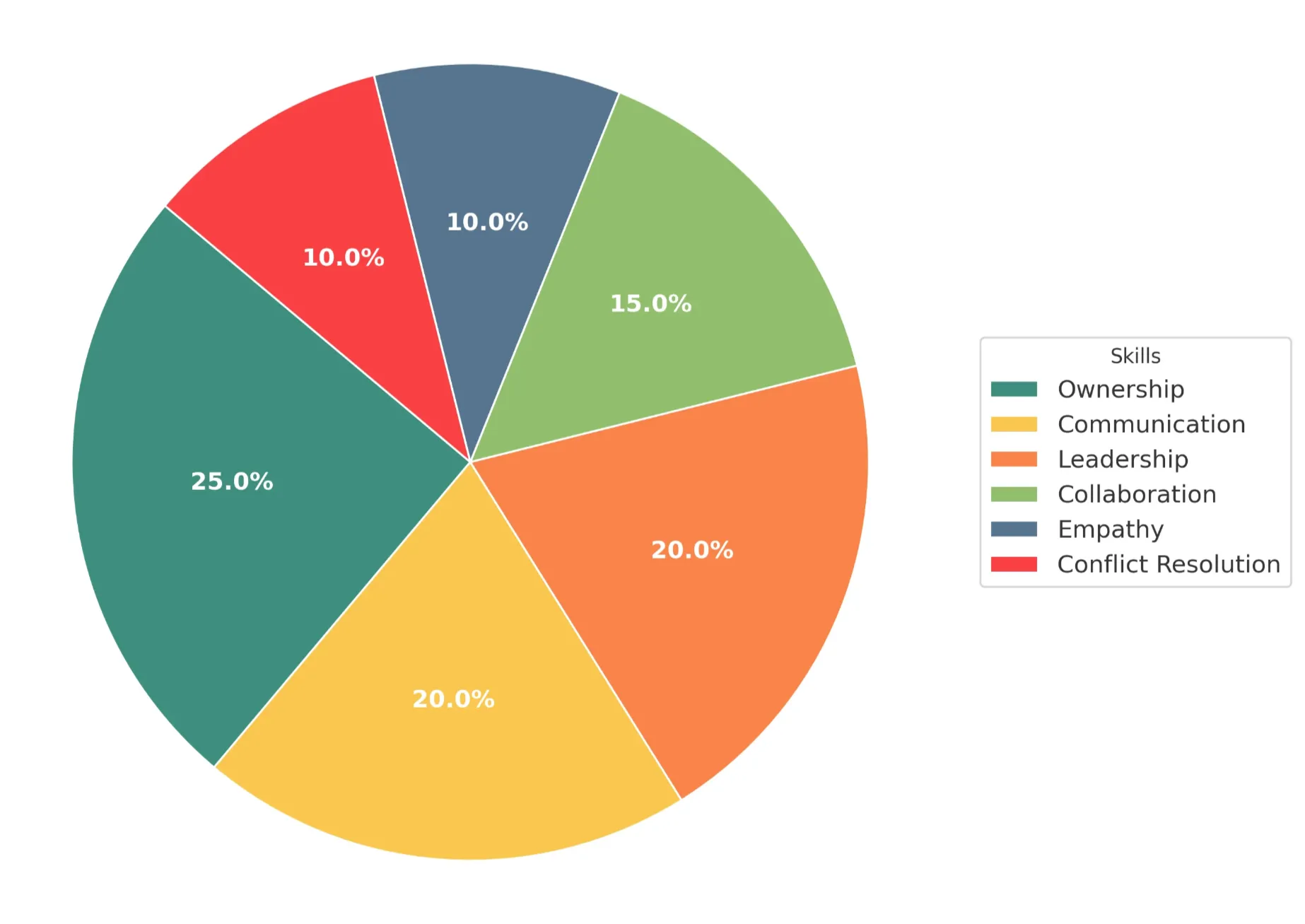
The Six Behavioral Competencies That Actually Matter
Forget generic lists of "soft skills." Based on multiple of PM interviews I've conducted and debriefs I've attended, here are the six competencies that consistently separate strong hires from passes:
1. Ownership Without Blame
They want to see you take responsibility for outcomes especially negative ones without throwing others under the bus. The worst answer could be "The engineers didn't deliver on time." A better one would be "I underestimated the technical complexity and should have pushed for better scoping upfront."
2. Influence Through Reasoning
They’ll test you if you can change minds using data, empathy, and clear logic rather than positional authority. The key is showing how you helped others reach conclusions, not how you convinced them you were right.
3. Conflict Resolution with Empathy
Stakeholder disagreements are inevitable. What matters is how you approach them with curiosity about their constraints and genuine effort to find mutual solutions.
4. Customer-Centric Decision Making
This isn't about reciting user research. It's about demonstrating that user needs genuinely influence your prioritization, even when it's inconvenient.
5. Learning from Failure
Everyone fails. What differentiates strong PMs is how they extract lessons and apply them. Bonus points if you can show how a failure improved your approach to similar situations.
6. Leading Through Ambiguity
PMs operate in uncertainty constantly. Can you make decisions with incomplete data, create clarity for your team, and adapt when new information emerges.
The STAR Method
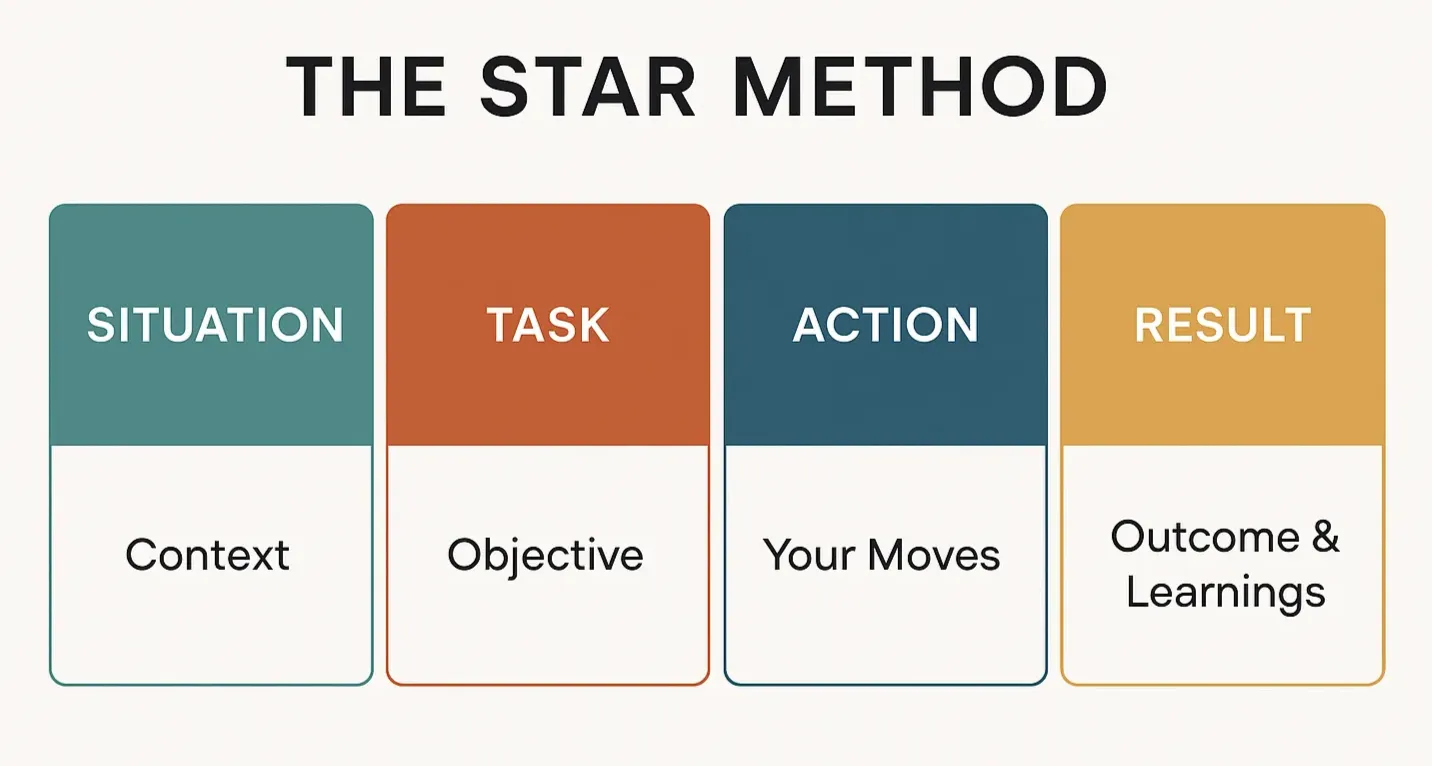
Yes, everyone knows STAR (Situation, Task, Action, Result). But most people butcher it. Here's how to use it properly:
Situation (15 seconds max): Set minimal context. "We were three weeks from launch when user testing revealed a major usability issue."
Task (10 seconds): Your specific responsibility. "I needed to decide whether to delay launch or ship with a known problem."
Action (60-70% of your answer): This is where you shine. Break down your specific actions:
- How you gathered information
- Who you consulted and why
- The trade-offs you considered
- The decision-making process you used
Result (15 seconds): Quantify when possible, but always include what you learned. "We delayed by one week, saw 15% higher conversion in the first month, and I learned to build more buffer time for user testing."
Example:
Bad version: "We had a conflict with engineering about technical debt. I convinced them we needed to address it. We spent two sprints cleaning it up and performance improved."
Good version: "Three months after launching a key feature, our engineering team was pushing back on new development, citing mounting technical debt that was slowing velocity by roughly 30%. As PM, I needed to balance immediate roadmap commitments with long-term platform health.
I started by sitting with two senior engineers to understand the specific pain points turned out our rapid feature additions had created database bottlenecks and messy interdependencies. I then mapped these technical issues to user impact: page load times had increased 40% and we were seeing more crashes.
Armed with this data, I made the case to leadership for a two-sprint investment. Instead of framing it as 'technical debt cleanup,' I positioned it as 'platform stability for scale' connecting it directly to our growth goals. We delayed two minor features but reduced deployment time by 60% and eliminated those performance issues.
The lesson? Technical debt isn't just an engineering problem it's a user experience problem that PMs need to translate and prioritize."
The Stories You Need in Your Back Pocket
Don't memorize scripts, but have clear examples ready for these common scenarios:
- Conflict with stakeholders: Pick a story where you genuinely disagreed on approach, not just timeline. Show how you understood their perspective before presenting yours.
- Failure or mistake: Choose something meaningful where you learned a concrete lesson. Avoid "learning experiences" that were actually just bad luck.
- Leading without authority: Focus on how you built credibility and motivated action. Engineers didn't listen because you asked nicely, they listened because you made their work easier or more impactful.
- Difficult prioritization decision: Show your decision-making framework. What data did you use? Who did you consult? How did you communicate the trade-offs?
- Customer empathy: Pick a moment when user insights actually changed your mind or approach, not just confirmed what you already thought.
The Three Prep Mistakes That Kill Interviews
1. Generic Company Research
Don't just memorize their values from the careers page. Dig deeper:
- Read the CEO's recent interviews or blog posts
- Check their product blog for decision-making patterns
- Look at their recent product launches for cultural clues
- Use their product extensively
Then subtly weave these insights into your stories. If they value "bias for action," emphasize quick decision-making. If they're data-driven, lead with metrics.
2. Perfect Success Stories
Interviewers see through flawless narratives. They want to understand how you think and grow, which only comes through authentic challenges and failures. The most memorable candidates are the ones who say, "Here's what I got wrong and how I fixed it."
3. Feature-Focused Examples
Too many PMs tell stories about launching features. Instead, focus on solving problems. The feature is just the solution, spend time on how you identified the problem, validated your approach, and measured success.
Advanced Behavioral Strategy: Reading the Room
As you get more senior, behavioral questions become less about individual experiences and more about leadership philosophy. Here's how to level up:
For Senior PM roles: Emphasize strategic thinking, cross-functional leadership, and building systems rather than just solving problems.
For startup interviews: Focus on scrappy execution, wearing multiple hats, and making decisions with limited resources.
For enterprise companies: Highlight stakeholder management, process optimization, and working within constraints.
For technical companies: Balance user empathy with technical depth, show respect for engineering complexity.
Practice That Actually Helps
- Record yourself answering questions: You'll be shocked at how much you ramble or how unclear your key points are.
- Get feedback from other PMs: They'll catch the gaps in your logic and push you on details.
- Practice with someone who doesn't know your work context: If they can't follow your story, neither will your interviewer.
- Time your answers: Aim for 90 seconds to 2 minutes. Any longer and you're losing their attention.
The Mindset That Changes Everything
The best behavioral interviews feel like conversations with a colleague, not interrogations. Approach each question with curiosity: "What does this question reveal about their challenges?"
If they ask about conflict resolution, they probably have alignment issues. If they focus on failure stories, they might be risk-averse. Use these clues to tailor your examples and ask thoughtful follow-up questions.
Remember: they want you to succeed. The behavioral round isn't about proving you're perfect, it's about showing you're self-aware, growth-oriented, and someone they'd want to work with during the inevitable chaos of product development.
Red Flags That Kill Your Chances
I've seen strong candidates messing up their interviews with these behavioral rounds. Avoid them at all costs:
The Blame Game
- Red flag: "The engineers were unrealistic about timelines" or "Marketing overpromised to customers"
- Why it kills you: Shows you don't take ownership and would likely create toxic team dynamics
- What to say instead: "I should have pushed for better technical scoping upfront" or "I didn't align marketing and engineering expectations early enough"
The Humble Brag Disguised as Failure
- Red flag: "I worked too hard and cared too much about the user experience"
- Why it kills you: You're not actually sharing a failure or showing growth
- What to say instead: Pick a real mistake where you learned something concrete
The Vague Success Story
- Red flag: "We launched the feature and users loved it"
- Why it kills you: No specifics, no metrics, no clear role definition
- What to say instead: Include specific numbers and your individual contributions
The Martyr Complex
- Red flag: "I stayed up all night to save the launch" or "I personally handled every customer complaint"
- Why it kills you: Suggests poor planning and inability to scale or delegate
- What to say instead: Focus on systematic solutions and team empowerment
The Perfect Team Fantasy
- Red flag: "Everyone agreed with my approach" or "We had no conflicts"
- Why it kills you: Shows you've never dealt with real product challenges
- What to say instead: Share authentic disagreements and how you navigated them
The Feature Factory Mindset
- Red flag: Stories that focus only on shipping features, not solving problems
- Why it kills you: Shows you think tactically, not strategically
- What to say instead: Start with the user problem, then explain your solution approach
Recovery Strategies: When Things Go Wrong
Even the best-prepared candidates hit roadblocks. Here's how to recover gracefully:
When You Blank Out Completely
- What happens: "Tell me about a time you failed" and your mind goes completely empty
- Recovery script: "You know what, let me take a moment to think of the best example for this question." Pause for 5-10 seconds "Actually, here's a situation that really challenged me..."
- Pro tip: It's better to pause and give a strong answer than rush into a weak one. Interviewers respect thoughtfulness.
When You Realize Your Story Is Going Nowhere
- What happens: You're 30 seconds in and realize your example doesn't actually demonstrate the skill they're testing
- Recovery script: "Actually, let me give you a better example that really shows [the skill they're asking about]..."
- Why this works: Shows self-awareness and adaptability both key PM traits
When You Give a Weak Answer
- What happens: You finish your response and can tell it wasn't compelling
- Recovery script: "Let me add one more thing that I think is important about this situation..." then share the key learning or impact you missed
- Don't: Apologize profusely or ask "Was that what you were looking for?" Just add value and move on
When You Can't Think of a Perfect Example
- What happens: They ask about a specific situation you've never encountered
- Recovery script: "I haven't faced that exact scenario, but here's a similar situation where I had to [relevant skill]..." or "While I haven't experienced that directly, here's how I would approach it based on a related challenge I faced..."
- Why this works: Shows problem-solving ability and honesty rather than trying to force-fit an irrelevant story
When You Accidentally Reveal Confidential Information
- What happens: You start sharing details you shouldn't (specific numbers, internal processes, etc.)
- Recovery script: "I should be more careful about confidential details, but the key point is..." then continue with the learning or approach without the sensitive info
When the Interviewer Looks Confused or Disengaged
- What happens: You can tell they're not following your story or seem bored
- Recovery script: "Let me get to the key point here..." then jump to your specific actions and the outcome
- Why this works: Shows you can read the room and adapt your communication style
The Universal Recovery Principle
When anything goes wrong, remember this: acknowledge briefly, then add value. Don't dwell on the mistake or over-apologize. Interviewers want to see how you handle uncertainty and pressure, your recovery is actually part of the assessment.
Your 48-Hour Prep Plan
Day 1: Write out 6-8 stories covering the core competencies. Use the STAR format and time yourself.
Day 2: Practice with a friend or record yourself. Focus on clarity, not perfection. Research the company deeply not just their values, but their product decisions and cultural signs.
The day before your interview, don't cram. Review your stories once, then focus on getting good sleep and showing up as your authentic self.
You've got this. The experiences that got you the interview are already impressive, now you just need to tell them well.