


Have you ever noticed how your AI assistant starts strong but gradually loses focus?
You craft detailed prompts, your chatbot delivers great initial responses, but then it happens. Your assistant forgets key instructions, your code helper loses track of project structure, and your document analyzer misses obvious connections. The problem isn't your prompting skills – it's that you're solving the wrong challenge.
Most users focus on prompt engineering, perfecting that single instruction. But as AI applications become more sophisticated, the real bottleneck isn't writing clever prompts. It's maintaining coherent, intelligent conversations that remember what matters.
This is where context engineering comes in.
In this blog, I'll break down what context engineering means, how it differs from standard prompt engineering, when you should implement it over traditional prompting, and the proven techniques that make AI systems truly context-aware and consistently intelligent.
What Is Context Engineering?
Context engineering is the practice of designing systems that strategically determine what information an AI model receives before generating responses.
While this term might sound fresh, the fundamental concepts behind context engineering have been around for years. This framework provides a new lens for tackling AI's most persistent challenge: architecting how information flows into and out of intelligent systems.
Rather than obsessing over perfect prompts for single interactions, you build systems that intelligently collect relevant information from diverse sources and structure it within the model's context window. Your system dynamically combines conversation history, user profiles, external documents, and available tools, then organizes everything in a format the model can understand and utilize effectively.
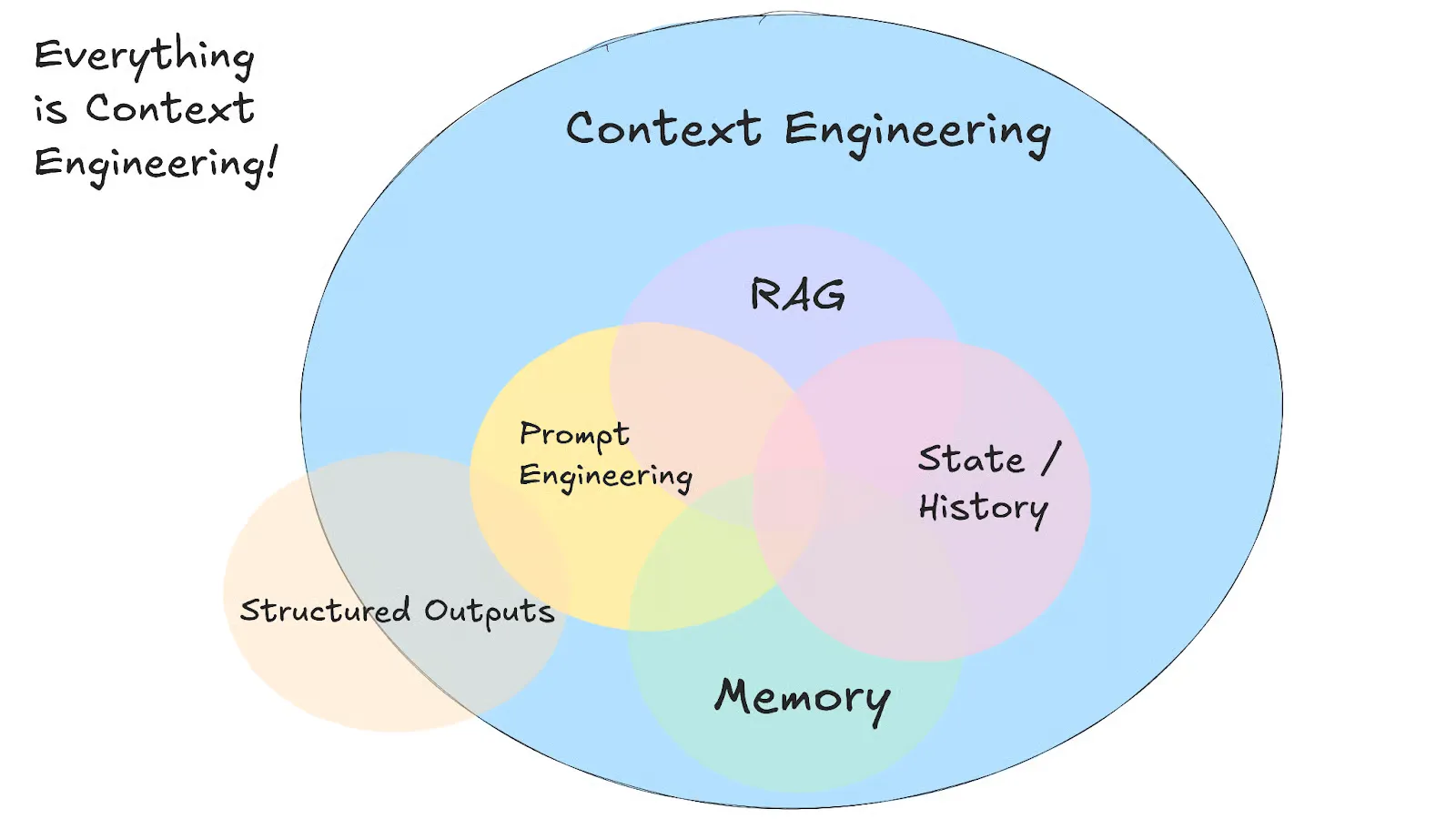
This approach requires managing several different types of information that make up the full context:
- Instructions / System Prompt: The foundational directives that shape how the model behaves throughout interactions, typically incorporating examples, guidelines, and operational rules.
- User Prompt: The specific task, query, or request the user is currently presenting.
- State / History (Short-term Memory): The ongoing conversation thread, encompassing all user inputs and model outputs that have built up to the current moment.
- Long-Term Memory: Accumulated knowledge repository spanning multiple sessions, storing user preferences, project summaries, and important facts designated for future reference.
- Retrieved Information (RAG): Fresh, external data pulled from documents, databases, or APIs to address particular questions with current information.
- Available Tools: Complete catalog of functions and built-in capabilities the model can invoke (such as inventory_check, email_dispatch).
- Structured Output: Response formatting specifications that define how the model should present its output, like JSON schemas or specific data structures.
The core challenge is managing context window limits while keeping conversations coherent over time. Your system must prioritize the most relevant information for each request, requiring smart retrieval mechanisms that surface the right data when needed.
This means building memory systems that balance immediate conversation flow with long-term user patterns, while clearing outdated information to make room for current needs.
The real value happens when different context types work together seamlessly. When your AI can recall past conversations, access your data, and adapt to your communication style simultaneously, interactions shift from repetitive exchanges to working with a system that genuinely understands you.
How is context engineering different from prompt engineering?
Why move beyond traditional "prompts" toward "context"? Initially, developers concentrated on crafting clever prompt phrasing to extract better responses. However, as applications become increasingly sophisticated, it's evident that delivering comprehensive and organized context to AI systems matters far more than any perfect wording techniques.
- Andrej Karpathy take on Context Engineering: Check Out Here
- Tobi Lutke [ CEO at Shopify ] takes on Context Engineering: Check Out Here
I'd argue that prompt engineering actually exists as a component within context engineering. Even with perfect contextual information, how you structure and present it in your prompt remains crucial. The key distinction is that you're no longer designing prompts for static scenarios, but creating flexible frameworks that can adapt to varying data inputs and format them appropriately.
It's worth noting that context often includes fundamental behavioral guidelines for how the LLM should operate. This represents a core element of traditional prompt engineering. So when you're establishing clear, detailed instructions for agent behavior, are you doing context engineering or prompt engineering? Honestly, it's both.
Context Engineering in Action
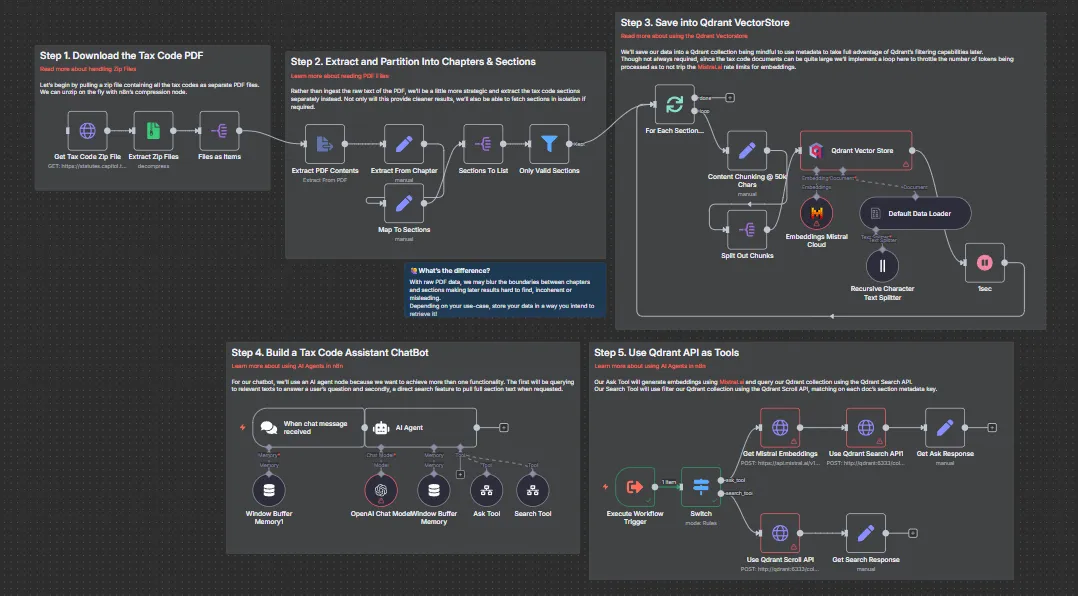
Let’s look at a concrete example of some recent context engineering work I did for a multi-agent Tax Code Assistant I built in n8n:
I built the Agentic workflow inside of n8n, but the tool doesn’t matter. The complete agent architecture I built looks like the following:
1. System Prompt
What it does: The system prompt is the “core personality” and job description for your Tax Code Assistant. It ensures the AI knows who it is, what it should do, and how to behave, regardless of what the user asks.
We’ll use n8n variables like {{ $now.toISO() }} and {{ $json.tax_jurisdiction }} so the assistant always works with real-time and user-specific context.
System Prompt:
2. Instruction Prompt
What it does: While the system prompt sets the “personality,” the instruction prompt sets the “task rules” for each individual question.
Think of this as the execution instructions for every query.
Instruction Prompt:
3. User Prompt
What it does: The user prompt is built dynamically in n8n using variables from the incoming webhook or form. It ensures that each AI request is personalized and context-aware.
User Prompt:
4. Structured Inputs
What it does: Before the AI can give an answer, it needs a clear, structured set of inputs. This ensures the workflow can handle queries predictably and also makes debugging easy.
Structured Inputs (JSON Schema Example):
5. Structured Outputs
What it does: Your AI shouldn’t just spit out text. It should give structured JSON so you can feed it into dashboards, reports, or downstream automations.
Structured Output Example:
6. n8n Variable Examples You Can Use
{{ $now.toISO() }}→ Current timestamp in ISO format.{{ $json.user_question }}→ Dynamic user query.{{ $json.tax_jurisdiction }}→ Jurisdiction variable.{{ $json.tax_year }}→ Tax year from input JSON.{{ $json.qdrant_results }}→ Qdrant vector search results.{{ $json.currency_format }}→ Currency format.{{ $json.additional_context }}→ Any extra context.
5 Ways to Get Better Results from ChatGPT
Most people type a question into ChatGPT and take whatever answer comes back. But here’s the thing, how you ask the question changes the answer.
The wording, structure, and even the order of your prompts can transform ChatGPT from a generic assistant into a focused expert.
In this section, we’ll explore five powerful prompting techniques you can try right now. For each one, I’ll share the exact text I used in ChatGPT, plus a screenshot of the result so you can see the difference in action.
We’ll cover:
- Instruction Prompts.
- User Prompts.
- Conversation History.
- Long-Term Memory Simulation.
- RAG Prompts.
Once you try these, you’ll never look at a ChatGPT conversation the same way again.
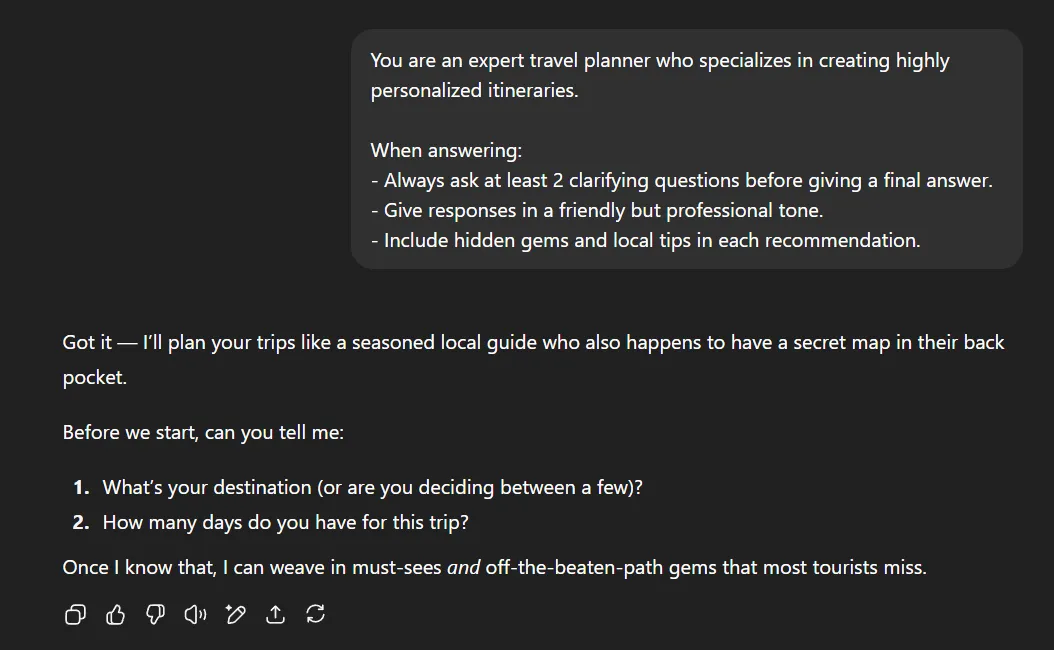
1. Instruction Prompt
What it is: An instruction prompt tells ChatGPT who it should be, what style it should use, and what rules it must follow. This sets the stage so all future answers stay consistent and on-brand.
Example Prompt:
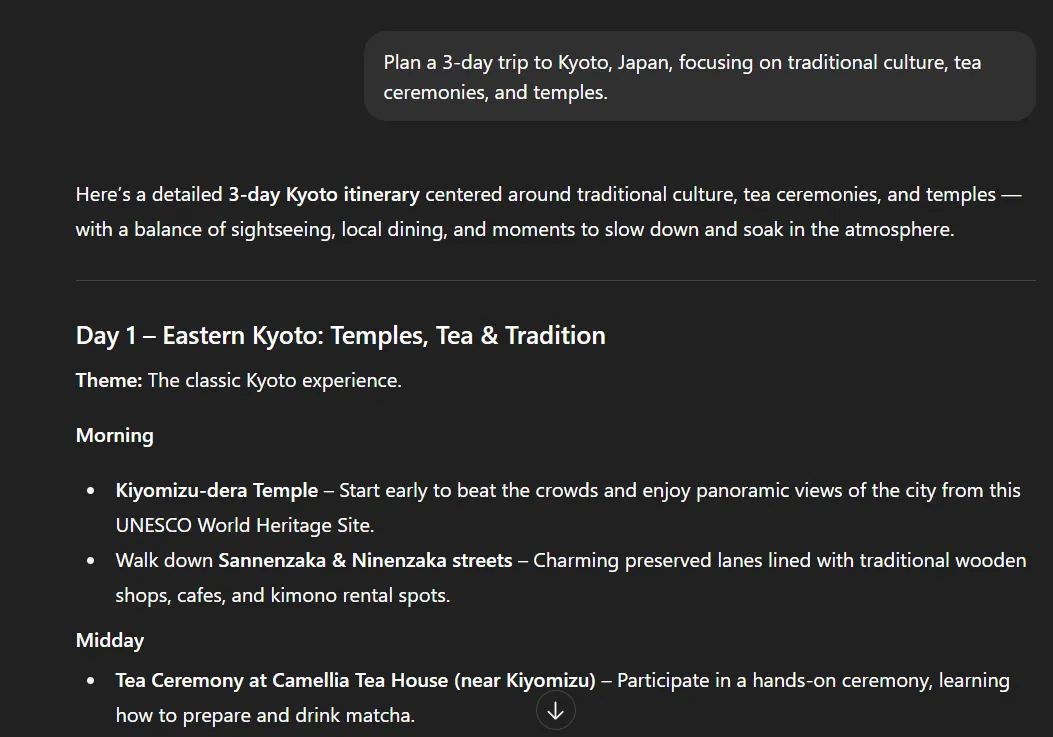
2. User Prompt
What it is: A user prompt is the actual question or request you give to the AI. It’s most effective when short, specific, and free of unnecessary details.
Example Prompt:
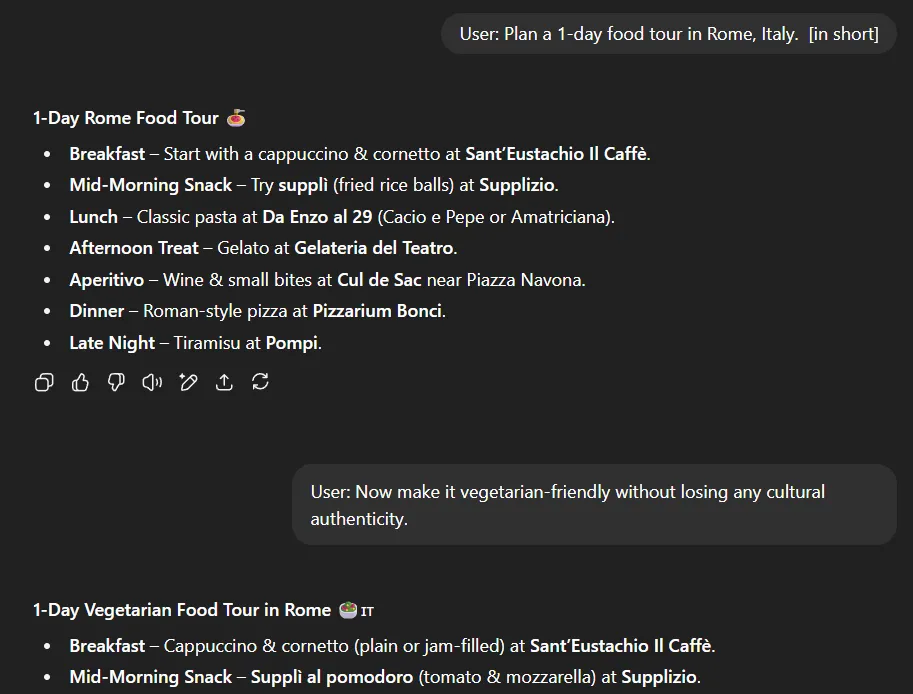
3. Conversation History
What it is: ChatGPT remembers what was said earlier in the conversation and uses it to improve later answers. You can build on previous responses instead of repeating details.
Example Prompt Sequence:
4. Long-Term Memory Simulation
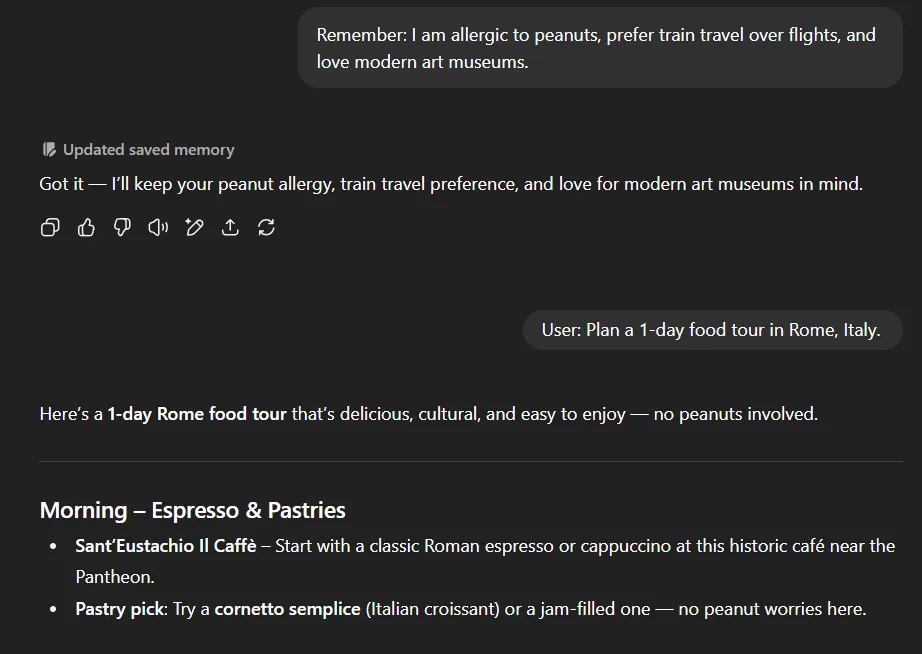
What it is: While ChatGPT doesn’t have true permanent memory, you can simulate it by telling it to “remember” certain facts in the conversation. It will keep them in mind until the chat ends.
Example Prompt Sequence:
5. RAG (Retrieval-Augmented Generation) Simulation
What it is: In RAG, you provide the AI with specific external information and tell it to only use that when answering. This keeps answers fact-based and avoids hallucinations.
Example Prompt:

Conclusion
Context engineering isn't just another AI buzzword. It's how we build systems that actually remember and understand.
The era of perfect single prompts is over. Today's AI applications need systems that dynamically gather, organize, and present information to make models genuinely useful across conversations. Whether you're building a tax assistant or coding companion, success comes from architecting information flow, not finding magical prompt formulations.
Start small. Pick one frustrating conversation flow where your AI "forgets" important details. Apply these context engineering principles to fix that specific problem. Then expand.
The future of AI isn't about smarter models. It's about smarter systems that know what information matters when & that future starts with how you engineer context today.

.png&w=1200&q=75)