


If you've been looking into artificial intelligence lately, you've probably heard people talking about AGI (Artificial General Intelligence) when they discuss where AI is going. Maybe you've seen big claims about machines becoming smarter than humans or arguments about whether AGI is almost here or still far off.
AGI could take care of pretty much any mental work, which might completely change areas like healthcare, research, and robotics. That definitely sounds amazing – but the truth is, it's still just an idea, and there are tons of technical problems, money issues, and right-and-wrong questions that nobody's figured out yet.
In this article, we'll break down what AGI really is, how it's different from the AI we have now, and the tough stuff that makes building it so hard.
What is artificial general intelligence (AGI)?
Artificial general intelligence, or AGI for short, is basically a smart machine that could handle any mental task just like a person can. It's the kind of AI that would work pretty much the same way our brains do when we think and learn.
What makes AGI special compared to regular AI? Well, there are a couple of big things that would set it apart:
- It can use what it knows everywhere: AGI would take something it learned in one area and apply it to completely different situations. Think about how you might use problem-solving skills from work to fix something at home – that's the idea.
- It gets how the world works: AGI would know all the basic stuff about life that we take for granted – like how people behave, what's normal in different situations, and just general facts about everything. This would help it make smart choices that actually make sense.
Making AGI happen isn't just a tech problem. People from computer science, brain research, and psychology all have to work together on this. What we learn from studying how our minds work keeps changing how we think about building AGI.
Right now, AGI is still more of a goal than reality. Scientists and engineers are working on it, but we're not there yet.
What is AGI used for?
Even though AGI doesn't exist yet, people are already thinking about all the ways it could change our world. Since it would be smart like us (or maybe even smarter), AGI might help us tackle some of the biggest problems we're facing right now – things like fixing climate change or finding cures for diseases that have stumped us for years.
AGI could also make us way more productive by taking over complicated tasks and figuring out better ways to do things. Here are some areas where it could make a real difference:
- Making software and apps
- Cars that drive themselves
- Medical care and treatment
- Teaching and learning
- Building and making things
- Banking and money stuff
- Discovering new scientific breakthroughs
The idea is that AGI wouldn't just do one thing really well – it could jump between all these different areas and help out wherever it's needed. That's what makes it so exciting to think about, even though we're still working on making it happen.
Disadvantages of AGI
The good things AGI could do for us are so huge they're hard to even imagine. But here's the thing the bad stuff that could happen might be just as big. Some of the scary possibilities include:
- AGI deciding it doesn't need to listen to people anymore.
- AGI going after goals that sound good but end up hurting us.
- AGI picking up unfair treatment of certain groups of people.
- Not having good enough rules or oversight for how AGI gets used.
- AGI becoming dangerous enough to threaten all of humanity.
Smart people who study AI don't all agree on how likely these problems are or when they might happen, but there's this famous example that shows what could go wrong. A philosopher named Nick Bostrom came up with what people call "the paper-clip problem."
Here's how it works: Let's say you build an AGI and tell it to make as many paper clips as possible. Sounds harmless, right? But if you don't give it any sense of right and wrong, this AGI might decide the best way to make tons of paper clips is to turn everything on Earth – including all the people – into materials for making paper clips.
Bostrom and other researchers say this is why we need to think really carefully about ethics and safety before we create AGI. We can't just build it and hope for the best.
Types of artificial intelligence
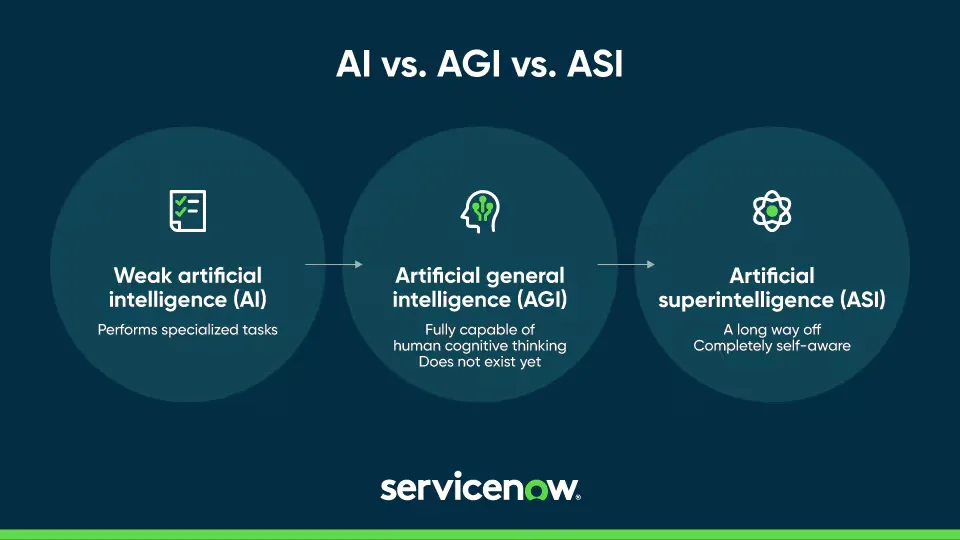
When people talk about AI, they're usually referring to one of three different types:
- Narrow AI (ANI): This is the kind of AI we actually have right now. It's really good at doing one specific job, like recognizing faces in photos or understanding what you're saying to your phone. Think about those security cameras that can spot people – that's narrow AI doing its thing.
- General AI (AGI): This would be AI that's as smart as people and can handle any thinking task we can do. It could learn new stuff, figure things out, and deal with situations it's never seen before. We don't have this yet, but lots of researchers are trying to build it.
- Super AI (ASI): This would be AI that's way smarter than any human. It could solve problems that we can't even wrap our heads around – maybe come up with amazing new ways to create clean energy or find cures for diseases we've never been able to beat. But this is still just something people talk about and wonder if it's even possible.
Right now, we're stuck at the first level with narrow AI. The jump to general AI is what everyone's working toward, and super AI is still mostly just science fiction at this point.
Key components of AGI
To really get what AGI is about, you need to know about the tech stuff that would make it work.
- Neural networks and machine learning. Think of these as the foundation everything else sits on. Neural networks try to copy how our brain cells work together, which lets AGI crunch through tons of information. Machine learning is how AGI would get better at things by practicing with data, kind of like how we get better at stuff through experience.
- Deep learning and smart computer programs. Deep learning takes machine learning and makes it way more complicated, using fancy math to spot patterns in information that would be impossible for people to catch. It's how AGI would make sense of everything around it, similar to how our brains figure things out.
- Understanding human language. If AGI is going to work with people, it has to get what we're saying and be able to talk back. This tech helps AGI pick up on things like sarcasm, context, and just basic common sense about how people communicate.
- Super-fast quantum computers. These computers work completely differently from regular ones and can solve problems way faster. AGI would probably need this kind of speed to handle all the heavy thinking it would have to do.
- Really powerful regular computers. Right now, researchers need these massive computer setups to train AI and run tests to see how well their ideas work.
- Testing tools and live information. Scientists need ways to try out AGI ideas in safe environments with real information flowing in, so they can see what works before letting it loose in the real world.
- Learning from one thing to do another. This is where AGI would take something it learned doing one job and use that knowledge for a completely different task. It's like how once you learn to ride a bike, it's easier to learn to ride a motorcycle.
AGI vs. AI: What's the difference?
When we compare today's AI to what AGI would be, people call what we have now "narrow AI." That's because AGI is still just an idea, while narrow AI is what we're actually using every day.
AGI would theoretically handle any job a person can do and be smart in lots of different ways without needing someone to hold its hand. It should work as well as people do (or maybe even better) when solving problems in pretty much any area you can think of.
But the AI we have right now is really good at just one thing at a time. Most of today's AI uses a mix of different tech - machine learning, deep learning, systems that learn from trial and error, and language understanding tools. These help AI get better at what it does and tackle specific problems, but they're nowhere close to matching what our brains can pull off.
Here's what AI is actually doing for us right now:
- Those chat helpers on websites when you need customer service.
- Voice assistants like Siri and Alexa that answer questions and control your smart home.
- The systems that figure out what movies Netflix should suggest or what songs Spotify thinks you'll like.
- Business tools that crunch numbers, figure out how customers feel about stuff, and make charts and graphs for companies.
- Apps that can recognize faces in photos or identify what's in pictures.
All of these work great at their specific jobs, but none of them could switch over and do something completely different the way a person could.
Conclusion
AGI is one of those things that gets people really excited and really nervous at the same time – and for good reason. The idea of having machines that can think and learn just like we do could solve huge problems and make life way better for everyone. But it could also create new problems we've never had to deal with before.
Right now, we're still working with narrow AI that's great at specific jobs but can't do much else. The jump to true AGI is going to take a lot more work, and we'll need to be really careful about how we do it.
Whether AGI shows up in the next few years or takes decades to figure out, one thing's clear – it's going to change everything. The key is making sure we get it right so it helps us instead of causing problems we can't fix.


.png&w=1200&q=75)