


Few industries operate under the same constraints as aviation.
There is no margin for error.
Downtime is incredibly expensive.
Failures don’t just cost money, they cost trust.
Every aircraft in the sky represents thousands of interconnected components, each with its own failure modes, usage patterns, and maintenance history. Managing that complexity at scale is not a human-only problem anymore.
That’s where Airbus made a strategic shift, not by “adding AI,” but by rethinking maintenance as a data and decision problem.
From Scheduled Checks to Anticipation
Traditionally, aircraft maintenance followed two models:
- Scheduled maintenance based on flight hours or cycles
- Reactive maintenance when something breaks unexpectedly
Both approaches work, but both are inefficient.
Scheduled checks often replace parts that still have usable life.
Reactive repairs lead to Aircraft-on-Ground (AOG) events that disrupt entire flight networks.
Airbus recognized early that the real opportunity wasn’t faster repairs, it was preventing disruption before it begins.
Skywise: The Real Innovation Isn’t AI - It’s the System
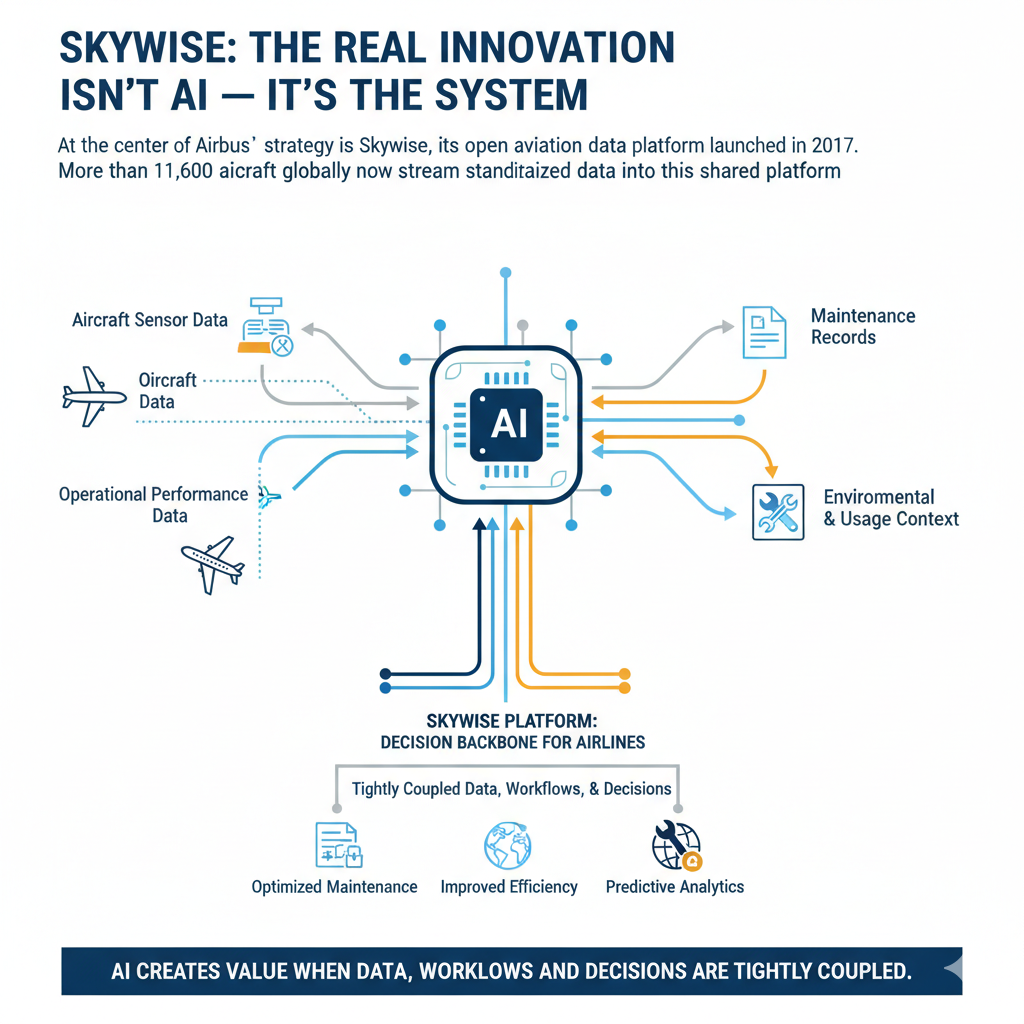
At the center of Airbus’ strategy is Skywise, its open aviation data platform launched in 2017.
Skywise connects:
- Aircraft sensor data
- Maintenance records
- Operational performance data
- Environmental and usage context
More than 11,600 aircraft globally now stream standardized data into this shared platform.
This matters because AI doesn’t create value in isolation.
It creates value when data, workflows, and decisions are tightly coupled.
Skywise isn’t just analytics infrastructure, it’s a decision backbone for airlines.
Why Predictive Maintenance Actually Works Here
Predictive maintenance sounds straightforward in theory. In practice, it only works when three conditions are met:
- High-quality, high-frequency data
- Clear failure definitions
- Operational ability to act on predictions
Aviation meets all three.
Using machine learning models, Airbus analyzes billions of parameters across engines, avionics, landing gear, and other systems to estimate probability of failure, not just detect faults.
That lead time, days or weeks instead of minutes, is what creates value.
Maintenance becomes a planning exercise, not a firefight.
The Digital Alliance: Why Collaboration Beats Proprietary Models
One of Airbus’ smartest moves was acknowledging a hard truth:
No single organization sees the full system.
In 2019, Airbus formed the Digital Alliance with:
- Delta TechOps (deep MRO expertise)
- GE Digital (industrial analytics and modeling)
Why this matters:
- Airbus understands aircraft design
- Airlines understand real-world wear and operational edge cases
- Analytics partners understand model scaling and validation
Together, they built predictive models covering hundreds of components, far beyond what siloed teams could achieve.
This is a powerful lesson for any industry:
The best AI models emerge from shared reality, not proprietary isolation.
Predictive Maintenance in the Real World
This isn’t lab-grade AI. It’s operational.
Vueling Airlines
Uses Skywise to anticipate maintenance needs and align them with fleet planning — reducing unscheduled events and improving aircraft availability.
Allegiant Air
Turns unplanned maintenance into scheduled interventions, minimizing service disruptions as operations scale.
Philippine Airlines
Deploys predictive maintenance across mixed fleets (A320, A330, A350), showing this isn’t limited to one aircraft type or region.
The common thread:
AI doesn’t replace maintenance teams, it reshapes how they plan, prioritize, and intervene.
What the Numbers Actually Mean
Industry-wide results from AI-driven predictive maintenance show:
- 10–15% reduction in maintenance costs
- ~20% improvement in scheduling reliability
- Up to 25% extension in component life
- Fewer AOG events
- Better inventory forecasting
For large carriers like Emirates, this translates into tens to hundreds of millions of dollars annually, largely from utilization and inventory optimization.
But the deeper win isn’t cost, it’s resilience.
Beyond Maintenance: A Different Operating Model
Predictive maintenance changes how airlines operate:
- Fewer delays and cancellations
- Better crew and fleet planning
- Feedback loops into aircraft design
- Continuous improvement across the lifecycle
Airbus’ use of digital twins strengthens this further, virtual replicas of aircraft that evolve with real-time data, enabling simulation-driven decisions long after manufacturing ends.
This is AI as infrastructure, not a feature.
The Human Role Still Matters - Critically
Despite the sophistication, AI doesn’t make final decisions.
Engineers and technicians:
- Validate predictions
- Assess safety implications
- Decide timing and execution
In aviation, AI is advisory by design, and that’s intentional.
High-stakes industries don’t automate judgment.
They augment it.
The Broader Lesson for Every Industry
Airbus didn’t succeed with AI because it had better algorithms.
It succeeded because it:
- Built shared data foundations
- Embedded AI into workflows
- Preserved human accountability
- Focused on preventing problems, not reacting to them
Predictive maintenance is just one expression of a deeper shift:
From fixing failures to designing systems that avoid them.
That’s a lesson far bigger than aviation.
.png&w=1200&q=75)